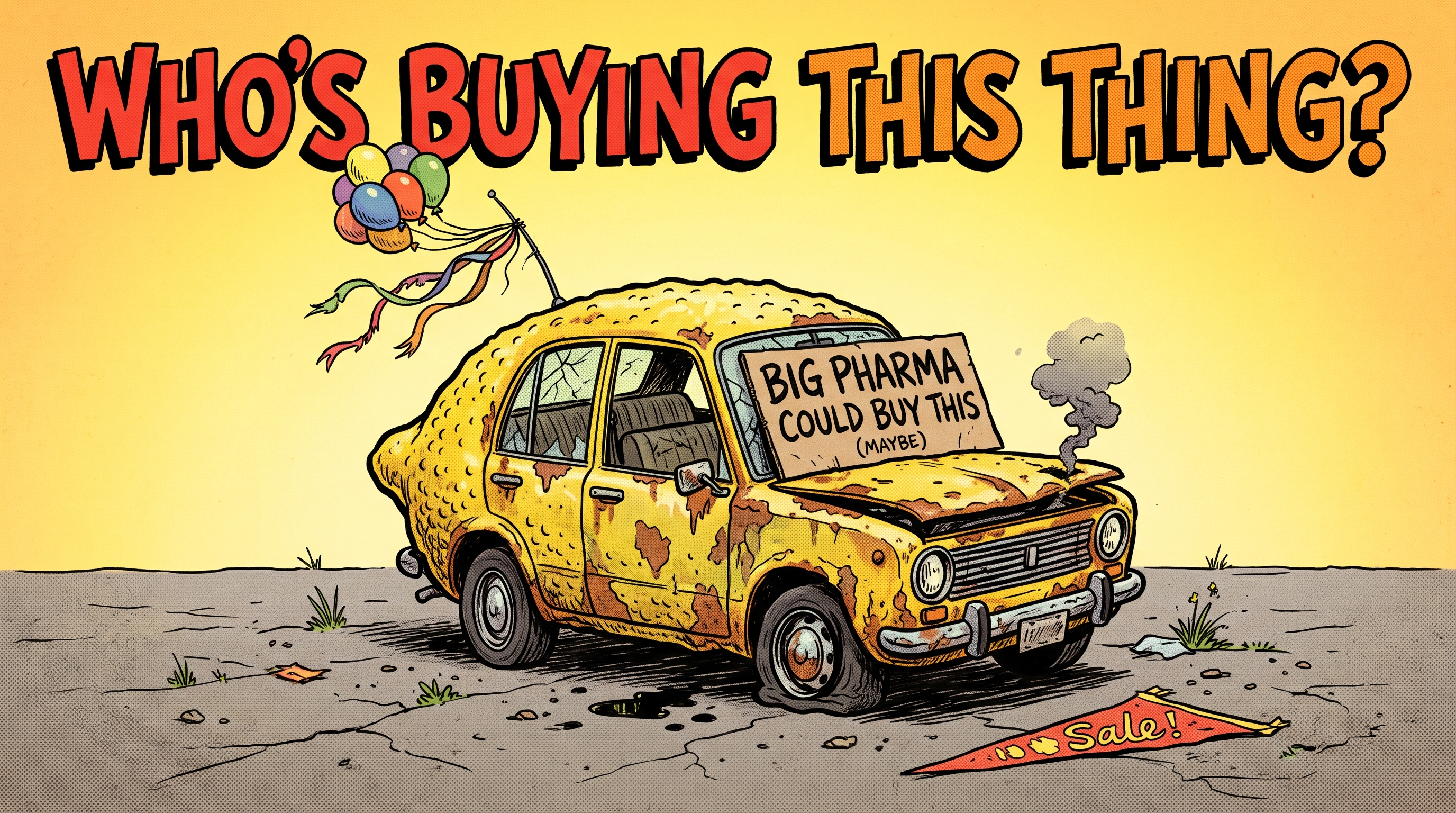
At some point, every biotech investor learns the most seductive phrase in the sector:
"Big Pharma could buy this."
Maybe.
M&A is a huge part of biotech. Large pharmaceutical companies constantly need new products, new technologies and new sources of future growth. Their own pipelines can fail. Existing drugs can lose exclusivity. Some therapeutic areas become strategically important. And sometimes a small biotech discovers something that a large company wants.
That creates an acquisition market.
The simplest version is easy to understand. Big Pharma has money. Small biotech has an interesting asset. Big Pharma buys the company. Shareholders receive cash or stock. Everyone goes home.
Reality is usually messier. The buyer may not want the whole company. It may want one drug. Or a platform. Or a technology. Or rights to a geographic market.
That is where licensing becomes important. A licensing deal can give a large company access to an asset without requiring an acquisition. The smaller company can receive an upfront payment. Then additional milestone payments may arrive if development, regulatory or commercial targets are achieved. Finally, the biotech may receive royalties on future sales.
This structure allows both sides to share risk. The big company doesn't necessarily spend billions on day one. The small company doesn't necessarily have to fund the entire development program alone. And investors get another signal. Someone with serious money has decided the asset is worth paying for.
That doesn't prove the drug works. It does, however, tell you something about how another sophisticated organization is approaching the opportunity.
M&A speculation becomes powerful because the stock market starts pricing the possibility before anything is announced. A small biotech rises. Someone posts:
"Potential acquisition target."
The rumor spreads. Analysts discuss strategic fit. Investors start imagining a premium. Suddenly the company is no longer valued purely on its pipeline. It is also being valued on the possibility that someone else might pay more.
This is where investors need to be careful. A company can look like an acquisition target and never get acquired. A drug can be strategically attractive and still fail clinically. A large pharmaceutical company can decide to build internally instead. It can license the asset rather than buy the company. It can wait. Or it can buy a completely different company.
The M&A thesis is therefore a possibility, not a business model.
Why does Big Pharma buy biotech?
Patent replacement is one reason. If a major drug is approaching loss of exclusivity, the company needs future revenue. Buying a successful or promising asset can accelerate that replacement.
Another reason is R&D productivity. Drug development is difficult. Many programs fail. Buying an external program can sometimes be faster than starting from scratch.
Another reason is technology. A company may want a new platform, delivery system, antibody technology, cell therapy capability or other scientific asset.
Then there is strategic positioning. A company may want to enter or strengthen a therapeutic area.
And sometimes the deal is simply about an asset that is difficult to reproduce.
This creates a useful framework. When you hear that a biotech might be acquired, ask:
What does the buyer actually want? The whole company? One drug? The platform? The intellectual property? The commercial infrastructure? The manufacturing capability?
Then ask: What would the buyer have to pay?
And most importantly: Would the biotech still make sense if nobody bought it?
That final question is underrated. If the entire investment thesis depends on an acquisition, the investor isn't really valuing the biotech. They are valuing a rumor about someone else's future decision.
M&A can be an enormous source of value creation in biotech. It can also become an enormous source of speculation. The difference is usually found in the asset itself.
Because the best acquisition stories usually start with something real. A drug. A platform. A technology. A patent. Something someone actually wants.
The rumor comes later.
References
- [1]IQVIA: Biopharma M&A: Outlook for 2026 (Jan. 2026). Patent-cliff pressure and pipeline replenishment as drivers of biopharma acquisitions.
- [2]SRS Acquiom / Fierce Biotech: Average biopharma biobucks decline, while upfront deal payments rise (Sept. 24, 2025). Analysis of how much of a headline biopharma deal value is paid upfront versus contingent on milestones.
- [3]STAT News (Damian Garde): What’s behind those billion-dollar biotech deals? Often, a whole lot of hype (Nov. 28, 2016). Why headline “biobucks” deal values overstate the cash a biotech actually receives.
- [4]U.S. Food and Drug Administration (FDA): Frequently Asked Questions on Patents and Exclusivity. How patents and regulatory exclusivity protect an approved drug and when generic competition can begin.
- [5]Merck & Co., Inc.: Annual Report on Form 10-K for fiscal year 2025 (filed Feb. 24, 2026). Keytruda revenue and the company’s disclosure on patent and market-exclusivity timing.
Educational content, not financial advice. Pfizer is referenced only in the companion scorecard as an illustrative example of a large pharmaceutical company, not as a recommendation to buy, sell, or trade any stock.