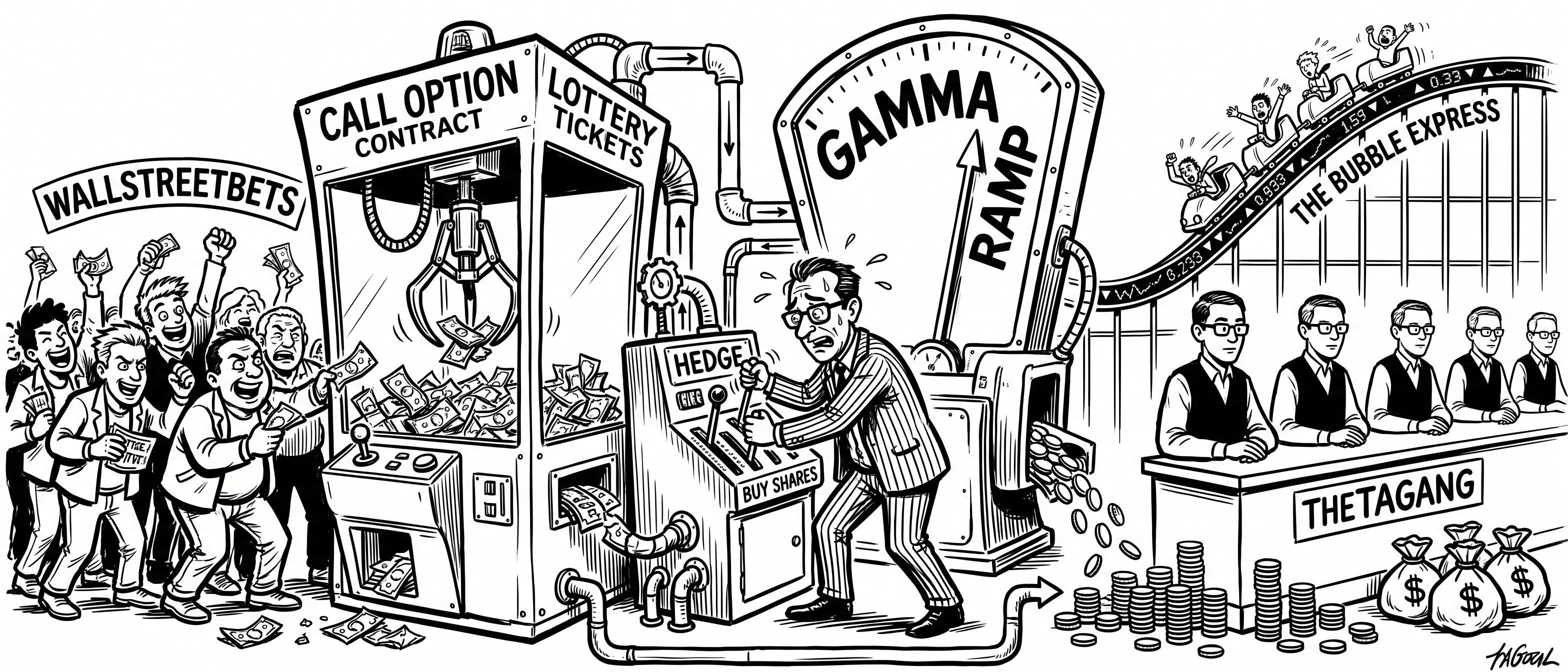
Turn on financial television, and you will hear the same exhausted narrative: retail investors are an undisciplined mob of "dumb money," mindlessly chasing meme stocks and buying short-dated options like scratch-off tickets.
It is a convenient caricature, but it misses what has actually happened over the past few years.
Retail finance has quietly evolved into two opposing, highly structured camps trading directly against one another. On one side sits r/WallStreetBets, the frantic optimists buying cheap, short-dated call options in search of a 500% lottery-ticket explosion. On the other side sits r/thetagang, the self-styled realists who sell those exact same contracts, aiming to collect steady, repeatable "rent" while waiting for time to expire.
These two tribes are not isolated internet forums. Together, they form a self-funding volatility engine that market makers, institutional desks, and algorithmic traders are forced to react to every single trading session.
The Two Mindsets: Lottery Hope vs. Collecting Rent
To understand how this dynamic moves stock prices, you do not need a degree in quantitative financial engineering or an understanding of complex options formulas. You only need to look at how each side views risk and reward.
Think of buying an option like buying a $2 scratch-off ticket:
- The Buyer (r/WallStreetBets): If the ticket is a dud, the most you can lose is that initial $2. Your downside hits a brick wall and stops. But if the underlying stock rockets, your payout has no ceiling—a $2 bet can balloon into $20, $50, or $100. This is asymmetric upside. The buyer accepts that they will lose small amounts frequently in exchange for the chance at an explosive, life-changing windfall.
- The Seller (r/thetagang): The seller is the corner-store clerk handing over that ticket. They collect your $2 up front and pocket it immediately. If the ticket expires worthless—which happens the vast majority of the time—they keep the cash. To them, this feels like prudent, disciplined landlord behavior: they own collateral, write a contract against it, and harvest time decay as the clock runs down.
One tribe pays for explosive hope; the other charges rent on certainty.
The Closed-Loop Flow: Who Funds Whom?
This creates a curious, almost parasitic symbiosis.
Statistically, between 70% and 80% of out-of-the-money options expire completely worthless. That means the constant, small losses suffered by optimistic buyers do not simply disappear into the ether—they flow straight into the accounts of the retail sellers, funding the 1% to 3% monthly yields that premium sellers boast about in their weekly spreadsheets.
In return, the sellers provide the exact liquidity the buyers need. Without a steady pool of retail capital willing to take the other side of an erratic options chain, these contracts would be too illiquid or carry bid-ask spreads too wide for retail gamblers to trade.
Notice, too, that both camps constantly obsess over the exact same basket of stocks: names like SOFI, Rocket Lab (RKLB), and Palantir (PLTR), alongside volatile giants like Nvidia and Tesla.
This is not a coincidence. An everyday trader running a $5,000 account cannot afford to back 100 shares of an expensive blue-chip stock with cold hard cash. A $15 or $25 stock, however, fits comfortably within a retail budget, while carrying enough wild daily price action to offer fat upfront cash premiums. The entire ecosystem naturally pools in the exact same sandbox.
Where It Spills Into the Wider Market
If this were simply two retail groups trading pocket change between themselves, institutional investors could safely ignore it. But it does not stay between them. It spills directly onto the main trading floor through the market maker sitting in the middle.
When thousands of retail buyers aggressively pile into short-dated call options, the institutional market maker who sells them those contracts cannot afford to take a wild gamble on the stock. To protect themselves, the market maker must instantly buy actual shares of the underlying company to stay neutral.
This triggers a reflexive loop:
- Retail volume rushes into out-of-the-money calls.
- Market makers mechanically buy shares to hedge their exposure.
- That mechanical buying pushes the stock price higher.
- As the price approaches the target strike prices, market makers are forced to buy even more shares to maintain their hedge.
This dynamic—often referred to as a gamma ramp—can launch a stock on an aggressive multi-day vertical climb that has nothing to do with corporate quarterly earnings, product announcements, or macroeconomic data. It is mechanical buying driven purely by the plumbing of options contracts.
The Hidden Steamroller
Eventually, reality reasserts itself, and this is where the premium sellers face their own reckoning.
Selling options gives the illusion of safety because the win rate is naturally high; you can be right eight or nine times out of ten. But the math hides an ugly catch. Collecting a 35-cent cash premium on a $15 stock feels like free money until a sudden earnings miss, a secondary share offering, or a broader market sell-off causes the stock to gap down to $9 overnight.
In a single morning bell, six months of disciplined "rent collection" can be erased. The seller finds themselves stuck holding shares of a cratering business at an artificially high cost basis—a dynamic veterans dryly describe as picking up pennies in front of a steamroller.
The Takeaway for Traders
Even if you never trade a single options contract, you cannot afford to ignore this dynamic.
Modern intraday price action, sudden afternoon liquidity vacuums, and inexplicable parabolic stock runs are frequently manufactured by the friction between these two retail forces and the mechanical dealer hedging that connects them.
The next time you see an erratic, high-beta stock break cleanly through technical resistance on zero fundamental news, look past the chart patterns. More often than not, it isn't an institutional repositioning or an economic turning point—it is simply the sound of the retail machine at work, where one side is desperately overpaying for hope, and the other is quietly renting out disaster for pocket change.
Educational content, not financial advice. SOFI, RKLB, PLTR, Nvidia and Tesla are referenced here only as illustrative examples of the price range and volatility that draw retail options flow — not as recommendations to buy, sell, or trade any of them.