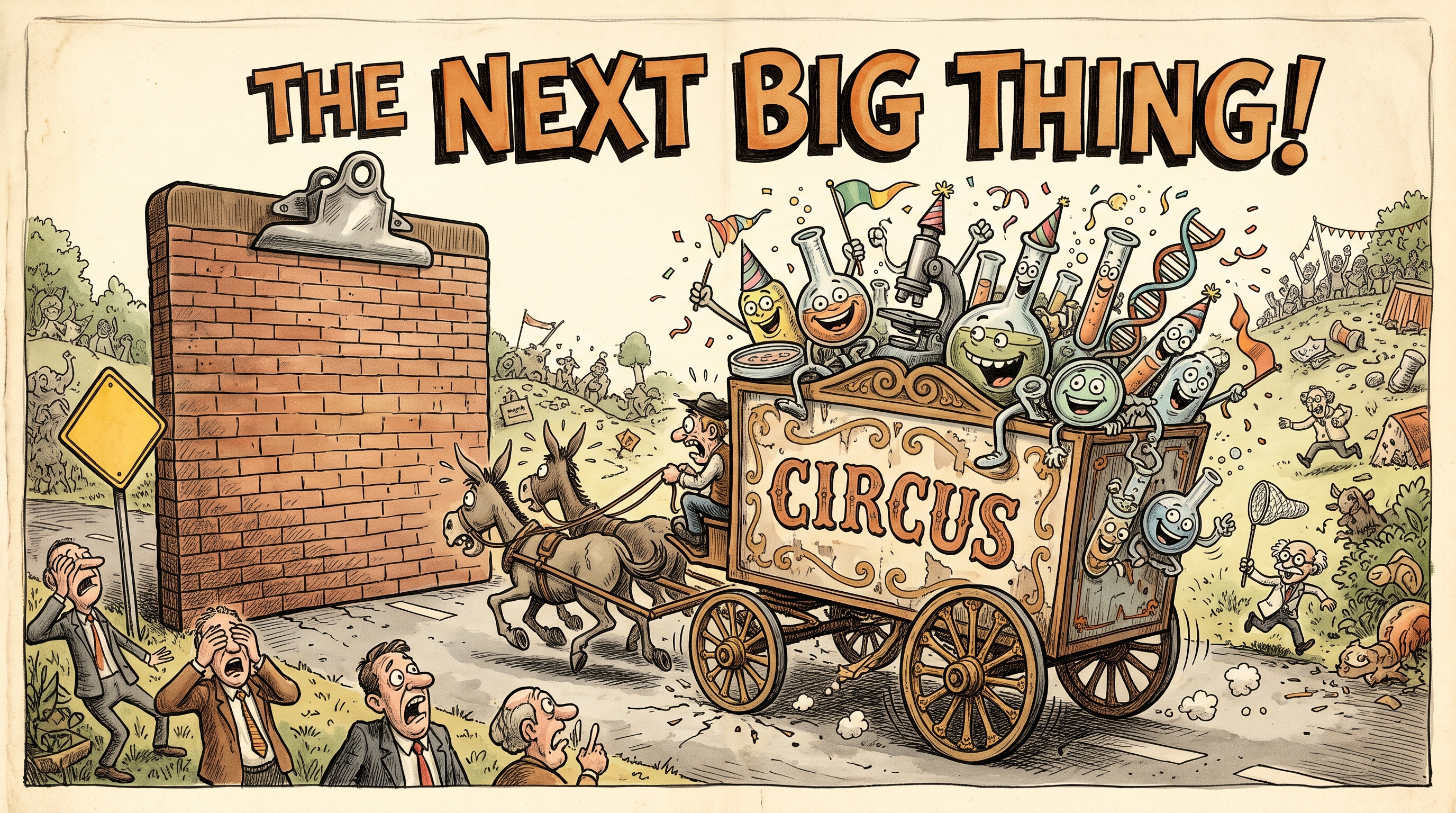
Every few years, Wall Street discovers a new category of medicine. The announcement usually comes with the phrase: "This changes everything." Sometimes it does.
GLP-1 drugs are the obvious modern example. Medicines for obesity and metabolic disease turned what was once treated as a relatively specialized market into one of the biggest pharmaceutical stories in the world. Eli Lilly and Novo Nordisk became the stars. Then came the supporting cast. Viking Therapeutics. Amgen. Structure Therapeutics. Pfizer. And plenty of other companies developing different approaches to the same enormous market.
This is how a therapeutic theme becomes a stock-market theme. First, somebody proves there is a market. Then investors realize the market is enormous. Then competitors appear. Then analysts start building enormous revenue forecasts. Then every company with a molecule vaguely connected to the theme becomes interesting. Eventually somebody puts "next-generation" in an investor presentation.
Congratulations. You now have a biotech sector.
Gene editing followed a similar path. CRISPR went from laboratory breakthrough to actual medicine. The approval of CASGEVY demonstrated that gene editing could move from scientific concept to an approved treatment. mRNA took another route. COVID demonstrated the technology at extraordinary scale. Now investors want to know what else mRNA might do. Cancer vaccines? Respiratory vaccines? Personalized medicine? Other diseases?
The science is fascinating. The stock-market interpretation is where things get messy.
Wall Street loves themes because themes are easy to sell. AI. GLP-1. Gene editing. ADC. CAR-T. Bispecifics. Precision medicine. Each becomes a bucket into which investors throw companies.
The problem is that not every company inside the bucket deserves the same valuation. A company with an approved blockbuster is not equivalent to a company with a mouse study. A Phase 3 drug is not equivalent to a laboratory concept. A company with billions in cash is not equivalent to one with six months of runway. But during a hot theme, those distinctions can temporarily disappear.
This is how biotech bubbles develop. The science creates something genuinely interesting. Investors discover it. Capital floods in. More companies form. More research gets funded. Valuations rise. The narrative gets stronger. Eventually, the market starts pricing perfection.
And that changes the question. It is no longer: "Could this technology work?" It becomes: "How much of the future success is already in the stock price?" That is much harder.
A company can be doing excellent science and still have an expensive stock. A company can be doing mediocre science while trading as if it invented the cure for aging. The theme tells you what people are excited about. It does not tell you what the company is worth.
And there is another problem. The bigger the theme gets, the more companies want to be associated with it. Suddenly everyone is an AI company. Everyone has a metabolic program. Everyone has a platform. Everyone is "transformational."
The investor's job is to remove the marketing labels and ask what actually exists. What is in humans? What has produced data? How much cash is left? Who are the competitors? What happens if the drug works? What happens if it doesn't?
Because eventually, every hot theme runs into the same cold object: the clinical trial.
That is where the story meets reality. And nobody feels that collision harder than the small biotech: one molecule, a beautiful slide deck and a very short runway.
Meet them next.
References
- [1]Viking Therapeutics, Inc.: Reports Fourth Quarter and Year-End 2025 Financial Results and Provides Corporate Update (Feb. 11, 2026). Status of the VK2735 obesity program, including the Phase 3 VANQUISH trials.
- [2]Amgen Inc.: The Story of Maridebart Cafraglutide (MariTide) (May 2026). MariTide’s advance into the Phase 3 MARITIME program.
- [3]Structure Therapeutics Inc.: Reports Positive Topline Data from ACCESS Program for Once-Daily Oral GLP-1 Receptor Agonist Aleniglipron (Dec. 8, 2025). Phase 2b results for the oral obesity candidate; later published in Nature Medicine (June 2026).
- [4]Pfizer Inc.: Completes Acquisition of Metsera (Nov. 2025). Pfizer’s purchase of the next-generation obesity portfolio.
- [5]U.S. Food and Drug Administration (FDA): FDA Approves First Gene Therapies to Treat Patients with Sickle Cell Disease (Dec. 8, 2023). Approval of Casgevy, the first CRISPR/Cas9 gene-edited therapy, and Lyfgenia.
Educational content, not financial advice. Eli Lilly, Novo Nordisk, Viking Therapeutics, Amgen, Structure Therapeutics, Pfizer and CRISPR-related companies are referenced here only as illustrative examples of hot investment themes — not as recommendations to buy, sell, or trade any stock, and no price target or forward return is implied for any company named.