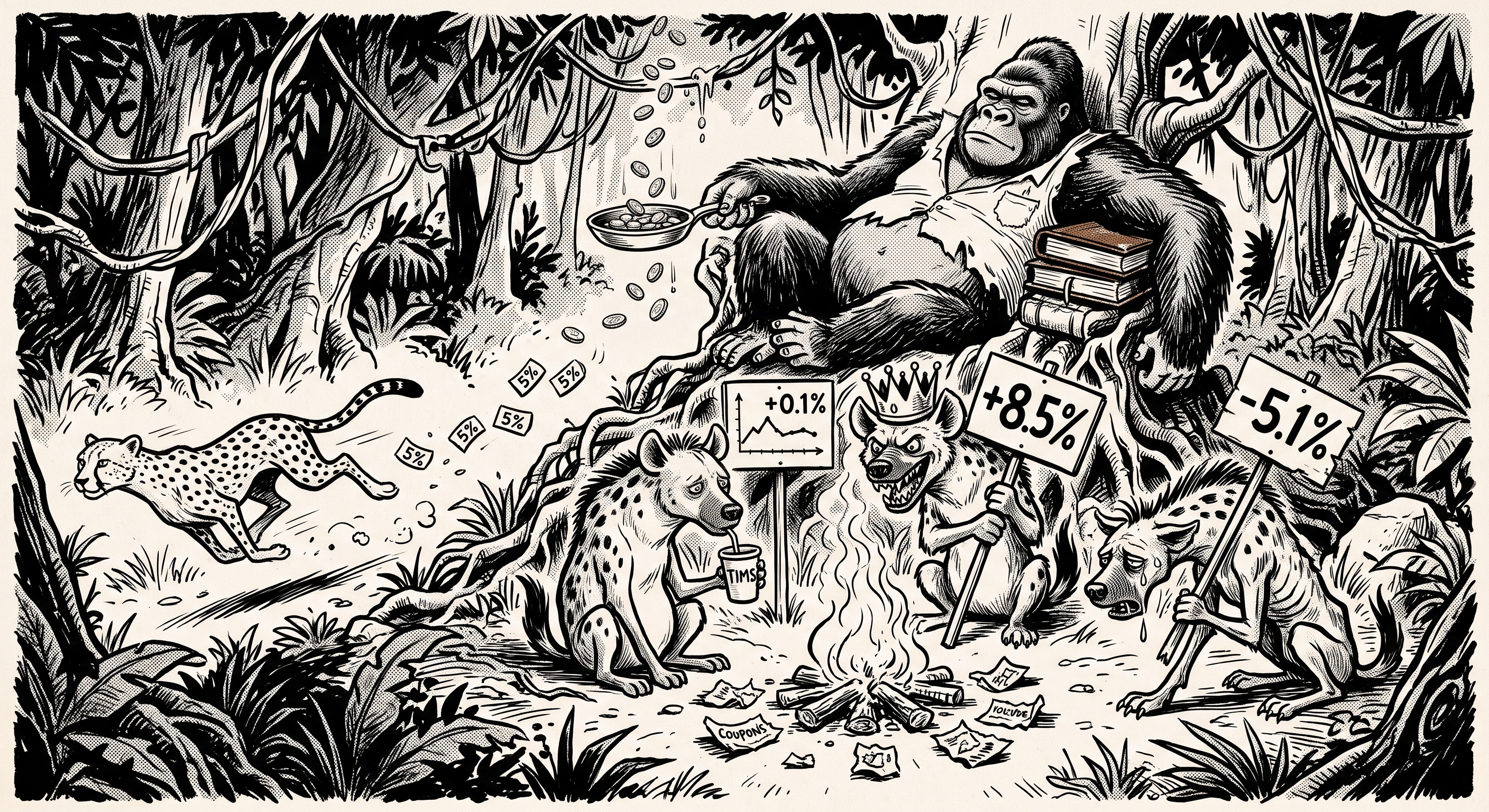
When retail equity research dresses up the fast-food sector in polite corporate euphemisms like "traffic normalization" and "promotional intensity," what they really mean is that the domestic watering hole is getting ugly, and the wildlife is behaving accordingly.
If you strip away the investor relations jargon, the global quick-serve-restaurant landscape is essentially three distinct species executing very different survival strategies.
The Silverback Landlord: McDonald's (MCD)
The Posture: P/E ~21x · Op Margin ~47% · U.S. Comps +0.8%
McDonald's is the bloated, unbothered apex primate sitting on top of the canopy. While retail analysts panic over anemic +0.8% domestic comps — because consumers finally realized paying eleven dollars for a mass-produced burger is absurd — the gorilla doesn't actually care.
MCD isn't a restaurant company; it's a global real-estate cartel with deep-fryers attached. It doesn't forage for margins; it charges feudal land-rent to franchisees, generating a bulletproof 47% operating margin. It moves slowly, grows units at a modest 2–3%, and treats the value-meal war like a mild weather pattern. It's the ultimate defensive fortress: boring, impenetrable, and collecting dividends from the dirt it owns.
The Scrappy Hyena Pack: Restaurant Brands International (QSR)
The Posture: P/E ~18x · Dividend Yield ~3.5% · Net Leverage ~4.1x
QSR doesn't travel with grace; it travels as an uneven corporate menagerie bound together by high leverage. Leading the charge is Burger King, newly swaggering with an +8.5% domestic sprint after setting hundreds of millions of dollars on fire in promotional remodeling.
Trailing behind is a Canadian caribou carrying coffee (Tim Hortons, flatlining at +0.1% comps) and an exhausted Louisiana chicken (Popeyes comps down -5.1%). Laden with debt and carrying an 18x multiple discount, this pack doesn't pretend to be refined. They live off scrappy value menus, hunt for turnaround arbitrage, and hand out a fat 3.5% yield to keep the market from noticing the leverage ratio.
The Nomad Cheetah: Yum! Brands (YUM)
The Posture: P/E ~22x · Net Unit Growth ~6% · Digital Mix >60%
Yum! looked at the cutthroat domestic price war and decided to simply leave the zip code. In a classic corporate amputation, it pocketed billions by offloading the capital-intensive Pizza Hut machinery, ridding itself of dead weight to turn into a pure-play, asset-light royalty collector.
While the gorilla defends its dirt and the hyenas scavenge value-meal coupons, YUM is sprinting across emerging international plains at a ~6% annual unit expansion rate. It finances nothing with its own capex, lets foreign franchisees take the localized balance sheet risk, and collects 5% off the top via mobile orders. It commands a premium multiple because it travels light, touches almost zero physical grease, and exports American sodium to 150+ countries without getting trapped in the domestic mud.
The Brand Stables
| Yum! Brands (YUM) | Restaurant Brands Int'l (QSR) |
|---|---|
| KFC | Burger King |
| Taco Bell | Tim Hortons |
| Pizza Hut | Popeyes Louisiana Kitchen |
| Habit Burger & Grill | Firehouse Subs |
The Takeaway
- Buy the Gorilla (MCD) if you want real estate equity disguised as french fries.
- Buy the Hyenas (QSR) if you want high-yield turnaround scavenging.
- Buy the Cheetah (YUM) if you want a global franchise tollbooth that leaves the kitchen headaches to everyone else.
Note to the Lawyers: This commentary is strictly satirical entertainment and intellectual field biology, not financial, investment, tax, or dietary advice. If you make portfolio allocation decisions based on a metaphorical showdown between an ape landlord and a caffeinated caribou, you deserve whatever beta you get. Consult a certified financial planner — or a licensed zookeeper — before risking your actual capital.