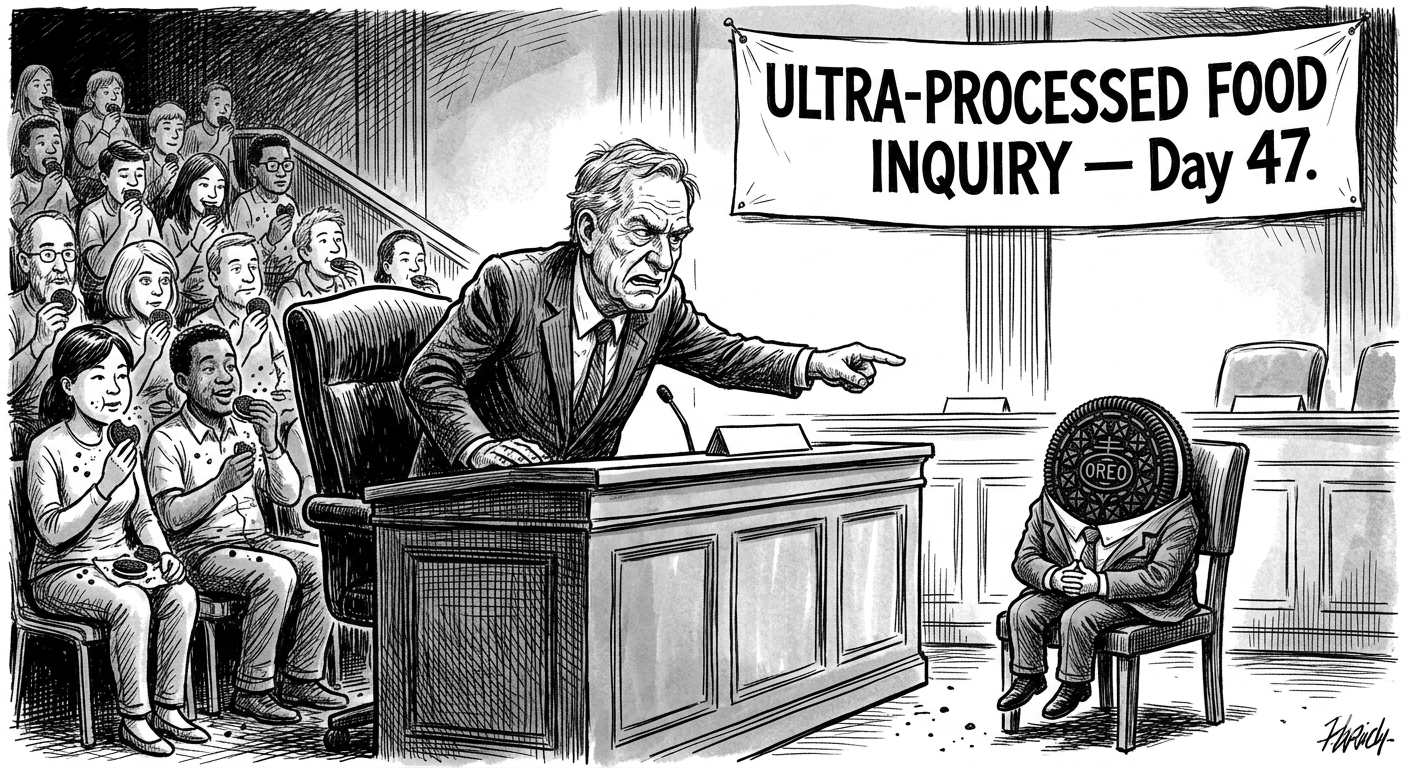
Isn't it fascinating to look back at the primitive history of the "snack"? There was a time—and historians assure me this is true—when a snack was an apple. Just a piece of fruit that grew on a tree, or perhaps a handful of nuts or a cold piece of leftover dinner. It was simple, it was natural, and let's be honest: it was incredibly boring.
But we've evolved. We've moved past the limitations of nature and into the glorious era of the laboratory-perfected masterpiece. Why settle for an apple when you can have a high-fructose, multi-layered biscuit engineered to stay exactly the same texture from the factory floor to your pantry? We didn't just innovate; we replaced nature with something much more reliable.
The "Guideline" Delusion
The US government just released the 2025–2030 Dietary Guidelines, and they've made a "groundbreaking" discovery: apparently, we should be eating less "ultra-processed" food. They've spent millions to tell you that the food you actually crave might not be the ideal fuel for your body.
It's a bold move for a government agency to take on the Oreo with a PDF. They think a pamphlet can compete with decades of dopamine mapping. While they're busy promoting "real food," companies like Mondelez and Hershey are busy making sure that their products remain the only thing keeping most of the population from a total breakdown.
The Cocoa Crisis (The West African Tax)
Now, the "experts" look at the books and see a problem. They see that 60% of the world's raw cocoa comes from the Ivory Coast and Ghana, and they see chaos. Between erratic weather and the delightful spread of Black Pod disease and the Swollen Shoot virus, the supply chain is as fragile as a thin sheet of tempered chocolate.
Production costs are climbing, with cocoa trading at roughly $3,200 per ton. Profitability has taken a rapid decline in adjusted margins. But while the analysts are sweating, thinking this is the end of the chocolate empire, the industry giants are just preparing to hand you the bill.
When a luxury becomes an essential service, price is just a suggestion.
The Rivalry: Global Giant vs. Domestic Icon
While Mondelez (MDLZ) and Hershey (HSY) are both fighting the same cocoa-flavored storm, they are playing very different games. Mondelez is the global predator, leaning into its massive international footprint and biscuit dominance to stay afloat. Meanwhile, Hershey is pivoting hard into "Salty Snacks" to hedge against the volatility of the bean.
Here is how the "big two" look as of May 6, 2026:
Mondelez vs Hershey — As of May 6, 2026
The Loyalty Test
We've spent generations turning Cadbury, Toblerone, and the Oreo into social requirements. Whether you're a Gen X-er looking for comfort or a Gen Z-er looking for a hit of sugar to survive a 15-second attention span, they've got you locked in.
Yes, they are passing those rising West African costs directly to you. We call it inflation; they call it a loyalty test. And you're passing with flying colors. Because when you're standing in an aisle at 5:00 PM, an apple feels like a chore, but a chunk of chocolate feels like a reward for surviving the day.
"Things sweet to taste prove in digestion sour."
— William Shakespeare, Richard II