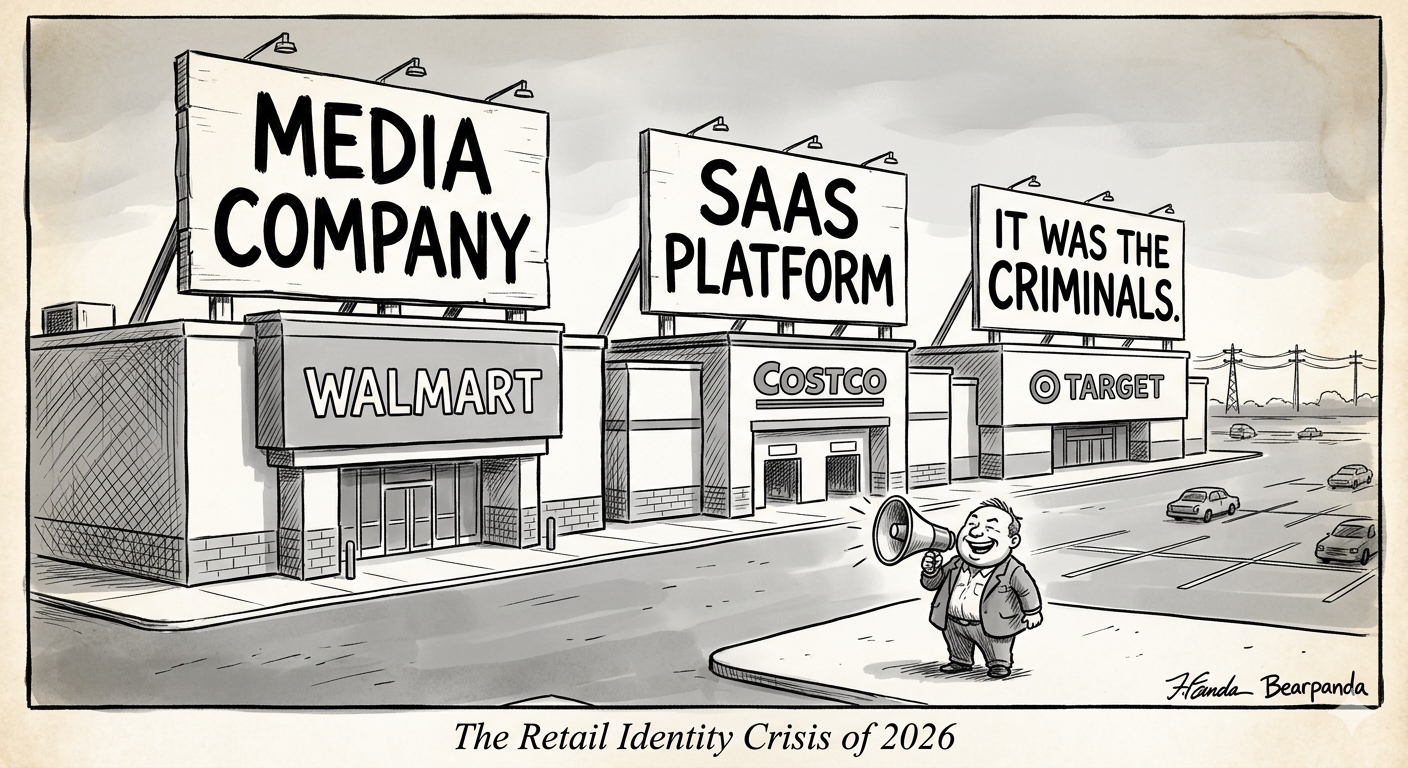
Selling cereal is a punishingly dull business. You buy a box for a dollar, put it on a metal shelf, and pray for an 11% gross margin after the lights are paid for. It is a terrible way to get rich and a worse way to justify a premium valuation. To survive, America's retail giants have performed a massive psychological pivot. They have realized that being a "store" is a legacy drag—to win, they must become high-margin tech platforms, annuity vehicles, or tragic victims of localized crime.
Let's look at the plumbing behind the physical shopping cart.
1. Walmart: The Ad Agency in a Blue Vest
The Sales Pitch: "We aren't just a store; we are an omni-channel ecosystem leveraging AI to revolutionize the global digital media landscape!"
The Mundane Reality: Look closely at Walmart (WMT) and you'll realize the groceries are just a loss-leader for their real business: harvesting your attention. Walmart doesn't just want to sell you Cheerios; they want to sell General Mills the right to show you a digital ad for Cheerios while you walk down the aisle.
"Walmart Connect" is currently surging, with global ad revenue hitting $6.4 billion—a 46% jump. It is a pure-margin digital tollbooth. They bought Vizio for one reason: to own the operating system in your living room. They want to inject shoppable ads directly into your retinas.
It's the ultimate floor-salesman pivot: "What's it gonna take to get you into this flat-screen TV today? Because frankly, the TV is free if I can legally sell your viewing habits to a detergent company."
2. Costco: The SaaS Warehouse
The Sales Pitch: "We offer an exclusive, curated treasure-hunt experience with unparalleled value and member loyalty!"
The Mundane Reality: Costco (COST) currently trades at roughly 50 times forward earnings—a multiple usually reserved for chipmakers. But investors love it because Costco isn't a store; it's a subscription service.
They don't make their net income on the pallets of toilet paper. They make it at the front door. They charge you a cover fee just to walk in, and with U.S. renewal rates sitting at 92.1%, that revenue is a guaranteed annuity. The rotisserie chicken and the $1.50 hot dog? Those are just the customer acquisition costs for their SaaS (Software as a Store) model.
It's the physical manifestation of the classic used-car hustle: "I'm practically losing money on this deal just to help you out, my manager is going to kill me!" Except at Costco, they actually are losing money on the chicken—just to ensure you pay the membership fee again next year.
3. Target: The "Shrink" Smokescreen
The Sales Pitch: "We are the premier 'expect more, pay less' destination for the stylish, modern guest!"
The Mundane Reality: While Walmart and Costco find new ways to monetize, Target (TGT) has spent the last few years leaning on a very loud, convenient excuse for their margin pressure: "Shrink."
They blame organized retail crime for the bleeding, but a peek at their filings reveals a more mundane culprit: "higher markdowns and purchase order cancellation costs." They misread the room, buying entirely too many expensive patio sets and curated home goods while inflation crushed their core demographic. Now, they are clearance-racking their way out of a self-inflicted inventory hole. It's much easier to tell Wall Street that criminals are robbing the stores than to admit your merchandising team simply bought the wrong stuff.
The "Over-Promised" Valuation Matrix
| Company | The Salesy Pitch | The Mundane Reality | Bearpanda's Verdict |
|---|---|---|---|
| Walmart (WMT) | "An AI-powered omnichannel media ecosystem." | An ad agency that sells milk so you'll look at their screens. | A tech stock in denial. |
| Costco (COST) | "A curated high-value membership experience." | A high-end toll booth for people who buy bulk toilet paper to feel rich. | SaaS multiples for a warehouse. |
| Target (TGT) | "A stylish destination for the aspirational guest." | A mid-tier clothing store blaming "the kids" for their bad inventory guesses. | The "Shrink" Scapegoat. |
Words of Wisdom
"The search for a scapegoat is the easiest of all hunting expeditions."
— Dwight D. Eisenhower
Bearpanda's Take: Target management has become the Hemingway of this particular hunting expedition. It's a lot easier to hunt for "organized retail crime" in your earnings report than it is to hunt for a merchandising strategy that actually works when people are too woke to buy a $45 throw pillow.
Data Sources & References
[1] Walmart Inc. (Form 10-K, 2026): Disclosing $6.4B in ad revenue and the Vizio integration strategy.
[2] Costco Wholesale Corp. (Q2 FY2026): Metrics on 92.1% US/Canada renewal rates and membership fee growth.
[3] Target Corp. (Annual Report 2025): Detailed analysis of inventory markdowns and the "shrink" impact on gross margins.