Quantum Computing Stocks: Real Revenue, Speculative Future
Quantum computing crossed a threshold in 2026 — real revenue, real customers — but the sector is still tiny, unprofitable, and priced for a future that hasn't arrived yet.
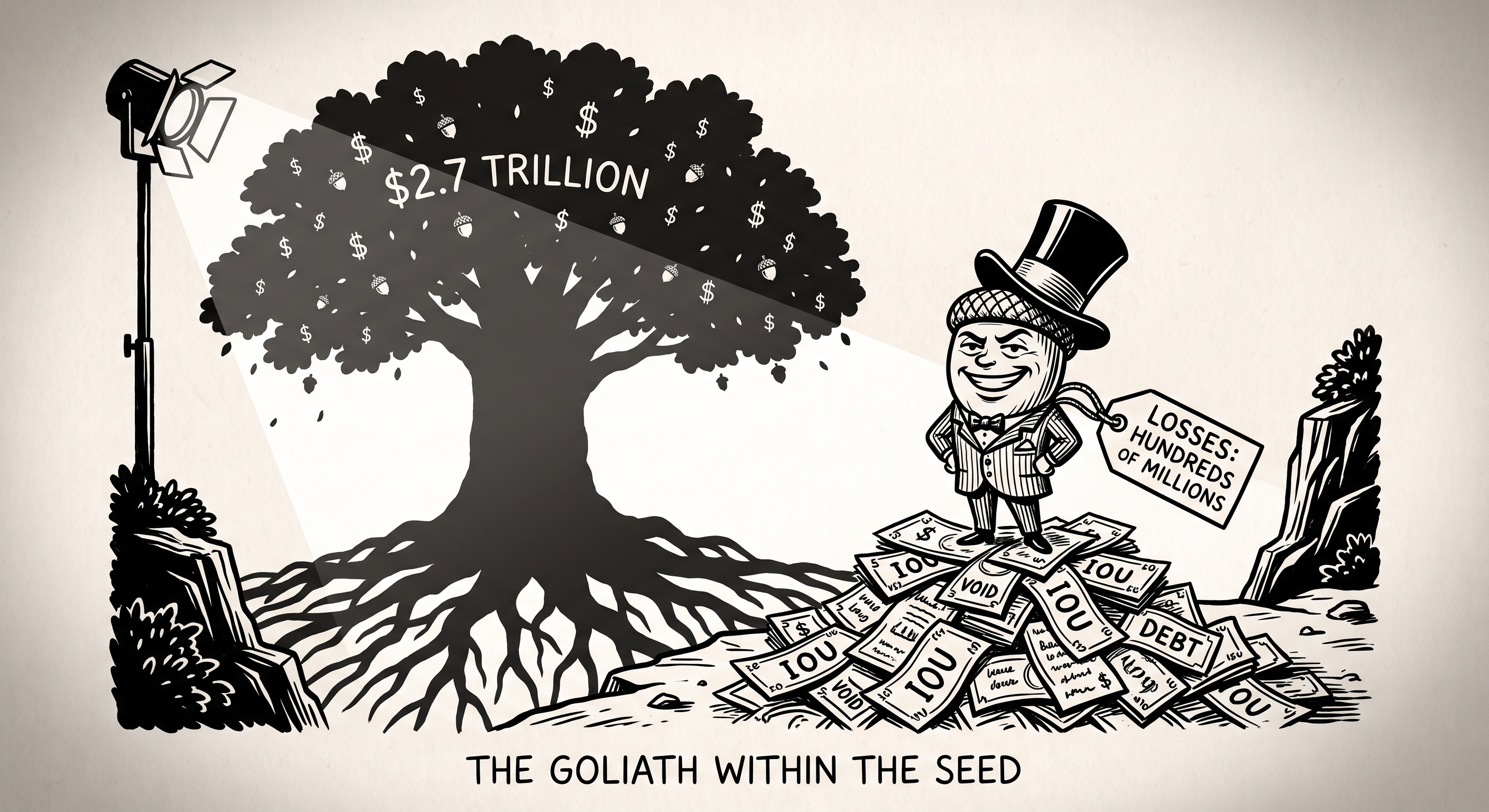
The acorn's delusions of grandeur — quantum's tiny market, priced for an oak-tree future.
Quantum computing has crossed a threshold in 2026: companies are posting real revenue and production deployments, yet the sector remains tiny, deeply unprofitable, and wildly volatile as an investment. For lay investors eyeing quantum stocks, the opportunity is less about today's earnings and more about a high-stakes bet on a technology that could reshape drugs, materials, finance, and national security over the next decade.
1. Real revenue, still no profits
The headline number that captures the moment is IonQ's second-quarter 2026 revenue: about $80 million, up 287% year over year, with the company raising its full-year guidance to roughly $280–290 million. Rivals show similar patterns: D-Wave's bookings surged more than 1,000% in the first half of 2026, while Quantum Computing Inc posted explosive percentage growth from a tiny base and a reported backlog of around $42.5 million.
But revenue is only half the story. All of the major pure-play quantum companies — IonQ, Rigetti, D-Wave, Quantum Computing Inc, Infleqtion — are still losing hundreds of millions of dollars a year and depend on future contracts, funding, and technology milestones to survive. In investment terms, quantum looks less like mature software and more like pre-profit biotech or early-stage AI: promising pipelines, real customers, and no clear path to broad profitability yet.
2. A trillion-dollar option on a billion-dollar market
The direct quantum computing market is still small. Estimates for 2025–2026 put it in the low single-digit billions of dollars, with projections of $8–20 billion by the early 2030s and $50–120 billion by 2035. McKinsey and others, however, see the economic value created for end industries — pharma, chemicals, finance, logistics, energy — reaching $1.3–2.7 trillion by 2035 if the technology delivers on its promise.
That gap is the heart of the investment thesis. Investors are not paying for today's cash flow; they are paying for optionality — the chance that quantum becomes a foundational capability, like semiconductors or electricity, that unlocks enormous value across the economy while the direct market remains concentrated among a handful of hardware and software specialists.
3. Pure-play stocks versus wrapped exposure
Investors can access quantum in three main ways, each with a different risk profile.
Pure-play quantum stocks are the most direct but also the most speculative. Names like IonQ (IONQ), Rigetti (RGTI), D-Wave (QBTS), Quantum Computing Inc (QUBT), and Infleqtion (INFQ) have core businesses tied to quantum hardware, software, or services. Their revenue growth rates are eye-popping in percentage terms, but they are small, loss-making, and subject to extreme price swings. IonQ's market cap hovered around $16–17 billion in mid-2026, while D-Wave and Rigetti sat in the $6–7 billion range, yet all have seen 50%+ drawdowns and sharp rebounds within months.
Big tech with quantum programs — IBM, Google (Alphabet), Microsoft, Amazon, Nvidia, Honeywell, and others — offers indirect exposure. For most of them, quantum is a small fraction of overall revenue, so buying these stocks is primarily a bet on their core businesses, with quantum as a long-term option layered on top.
Quantum-themed ETFs sit in between. The Defiance Quantum ETF (QTUM) holds around 80–90 companies spanning quantum, AI, and semiconductors, with top holdings typically 1–2% each — so its performance has been driven largely by big tech and AI rather than the small pure-plays, and it was up roughly 30–38% year-to-date in 2026. By contrast, the WisdomTree Quantum Computing Fund (WQTM) weights holdings by "quantum revenue purity," making it more concentrated in speculative names, more volatile, and it has underperformed QTUM since inception. The core trade-off across funds is the same: more quantum purity means more risk.
4. Policy tailwinds and security stakes
Quantum is not just another tech theme; it is a geopolitical and national-security priority. Governments are pouring money into quantum research and infrastructure, and recent White House executive orders have signaled fresh policy support. The reason is twofold: quantum computers could eventually break much of today's public-key encryption, and they could accelerate breakthroughs in materials, drugs, and AI that carry strategic value.
That backdrop shows up in the numbers. Cumulative deal value in quantum reached roughly $2.6 billion by early 2026, with annual contract volume up more than sixfold since 2021, driven in part by government and defense-related customers. For investors, this means quantum stocks are partly a bet on continued state support, not just commercial demand.
5. Volatility is the product
If there is one thing every lay investor should understand about quantum stocks, it is that volatility is not a side effect; it is central to the investment experience. In August 2026, Rigetti, IonQ, and D-Wave all fell 4–7% in a single session amid a sector-wide selloff with no earnings or company-specific trigger — then jumped 7–10% days later on another wave of buying, again without fresh news. Over a longer window, IonQ's shares rallied past $70 in early June before crashing roughly 50% within weeks, even as the company raised guidance and posted strong revenue growth. For many holders, the day-to-day reality of quantum investing will be whipsaw price moves driven by macro sentiment and headlines as much as by quantum itself.
What this means for a lay investor's story
- Quantum computing in 2026 has real revenue and real customers, but it remains a pre-profit, high-risk sector with a long road to scale.
- Investors can choose between high-volatility pure-plays, diversified quantum-themed ETFs, and big tech with quantum R&D, each offering a different mix of risk and exposure — set against a backdrop of government policy and security concerns as key drivers.
- Extreme price swings are likely to remain a defining feature, especially for the pure-play stocks.