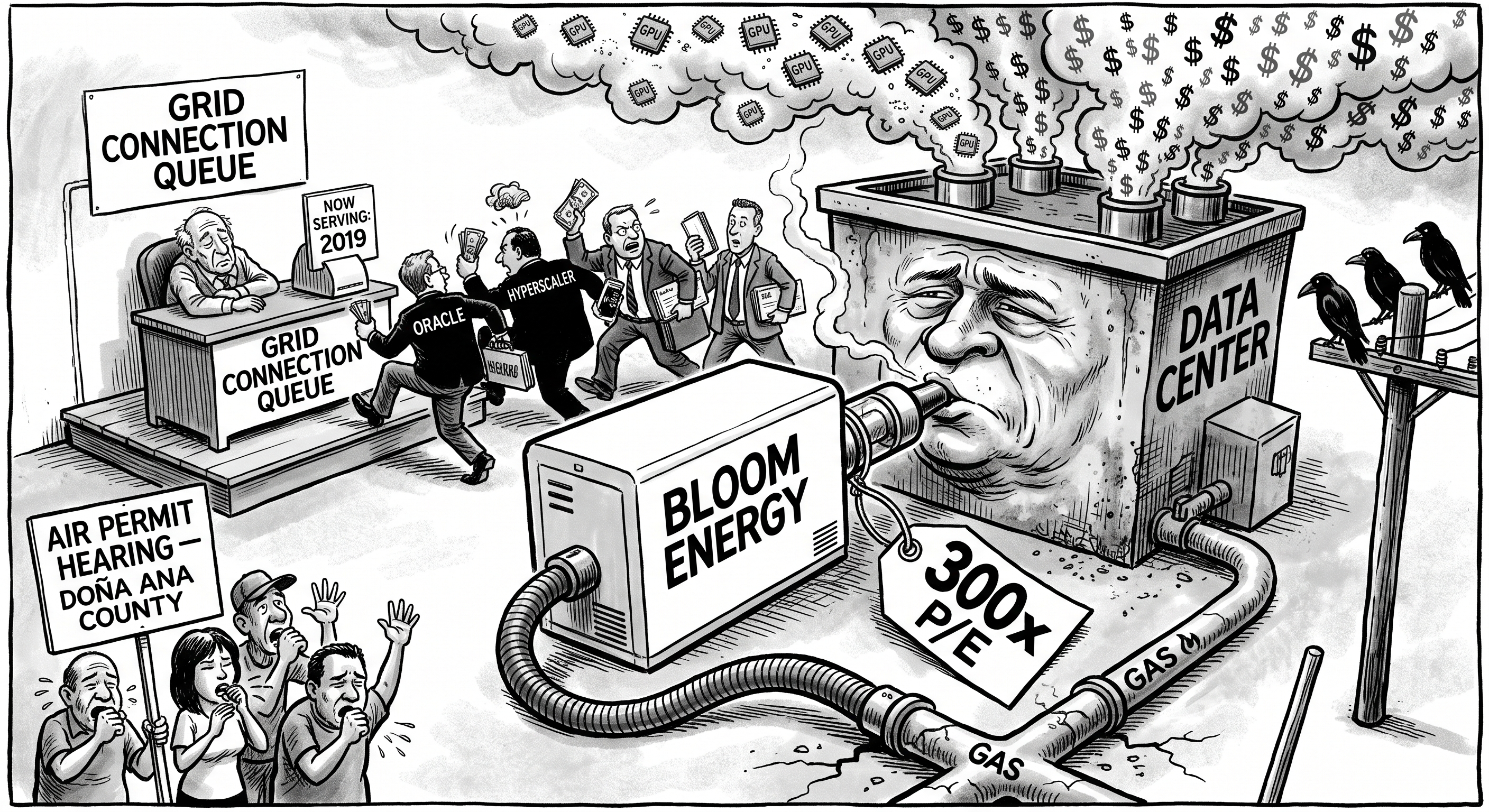
Let us pause and offer a moment of silence for the regional electric utilities. For decades, they enjoyed a cozy, boring existence monopolizing power grids and charging you $120 a month to run your air conditioner. Then Sam Altman and Jensen Huang showed up demanding three gigawatts of power by next Tuesday so an AI chatbot could generate higher-resolution images of cute cats riding monocycles.
The utility companies choked on their coffee and told the tech bros that connecting a new gigawatt-scale data center to the grid would take roughly five to seven agonizing years.
Enter Bloom Energy ($BE), Wall Street's new favorite poster child.
1. The Industrial Vape
Calling Bloom a "clean green energy play" in 2026 is like calling a monster truck an eco-friendly bicycle because it occasionally drives past a park. Strip away the corporate ESG gloss, and Bloom's solid-oxide fuel cell is essentially a $25-billion, hyper-turbocharged industrial Juul pod that hooks straight into a natural gas pipeline.
When hyperscalers can't wait five years for the grid, Bloom rolls up to the construction site in 90 days flat and slams down boxy, white, energy-dense metal refrigerators that guzzle fossil fuels so GPUs can crunch algorithms uninterrupted.
2. The Multiple Nobody Can Justify
And holy mother of multiples, the market is addicted to it. Wall Street traded $BE up to a mind-bending 300x trailing P/E ratio, pricing it less like an industrial equipment manufacturer and more like a magical elixir that turns natural gas into pure, unfiltered silicon validation.
The euphoria hit fever pitch in Q2 when Bloom dropped a staggering $1.1 billion revenue quarter — up 166% year-over-year — while flexing gross margins near 34%. Management immediately raised full-year guidance to over $4 billion, leaving short sellers weeping into their spreadsheets. Oracle signed up for up to 2.8 gigawatts of Bloom's off-grid juice, while Brookfield Infrastructure casually expanded its microgrid deal up to $25 billion. It's the ultimate "pick-and-shovel" play: why buy the AI software when you can sell the caffeine pills to the servers building it?
3. The Drama
Of course, no financial fairy tale is complete without a little drama. While the stock rallied over 149%, it recently took a 39% plunge off its summer highs because local regulators and short sellers suddenly remembered that these magic boxes still burn natural gas.
Down in New Mexico, Oracle's ambitious $165 billion "Project Jupiter" campus ran headfirst into state regulators over air permits and local emissions concerns. Turns out, even when you swap a traditional gas plant for a pristine fleet of sleek white fuel cells, local communities still notice when you're hooking an industrial gas pipeline directly to the local water table.
The Vape Cloud Matrix
| The Fallacy | The Corporate Spin | The Cold Ledger |
|---|---|---|
| Clean Green Energy | "We provide clean, off-grid power for the AI economy." | A 90-day industrial fuel cell that runs on natural gas piped straight to the site. |
| Durable Growth | "166% YoY revenue growth reflects a structural energy shift." | A 300x trailing P/E pricing equipment like a magic algorithm-to-silicon converter. |
| Regulatory Compliance | "Clean enough to clear local hurdles instantly." | Doña Ana County regulators pushing back on air permits for a 2.45GW deployment. |
The Verdict
Bloom Energy isn't being bought by AI hyperscalers because it's green; it's being bought because it's fast, reliable, and "clean enough" to clear regulatory hurdles. When an AI company needs a gigawatt of 24/7 power today and the local utility says "wait five years," a lower-emission natural gas fuel cell you can install in 90 days wins every single time.
So where does that leave us? Bloom Energy remains the undisputed king of the "we need power right now or our stock price dies" trade. As long as regional power grids remain hopelessly gridlocked and AI hyperscalers keep drowning in cash, Bloom will keep selling its high-priced gas-vapes to desperate tech titans. Just don't look too closely at the valuation multiples — or the gas meter spinning outside the server farm.
References
[1] Bloom Energy Q2 2026 Earnings Report (July 28, 2026): Revenue reached $1.065B (+165.5% YoY), gross margin expanded to 34.3%, and full-year 2026 guidance was raised to $3.9B–$4.2B.
[2] Oracle Master Services Agreement (April 2026): Strategic framework agreement allocating up to 2.8 GW of Bloom Energy solid-oxide fuel cell capacity for OCI cloud expansions.
[3] Brookfield Asset Management Framework Expansion (June 2026): $25 billion AI microgrid financing deal for rapid off-grid power deployment.
[4] Project Jupiter Regulatory Filings (Doña Ana County, NM, 2026): Filings detailing the planned deployment of up to 2.45 GW of Bloom solid-oxide fuel cells to bypass local grid delays for Oracle's $165B campus.
Note to the Lawyers: This is satirical commentary. All financial data is sourced from public earnings reports and regulatory filings. Not investment advice.