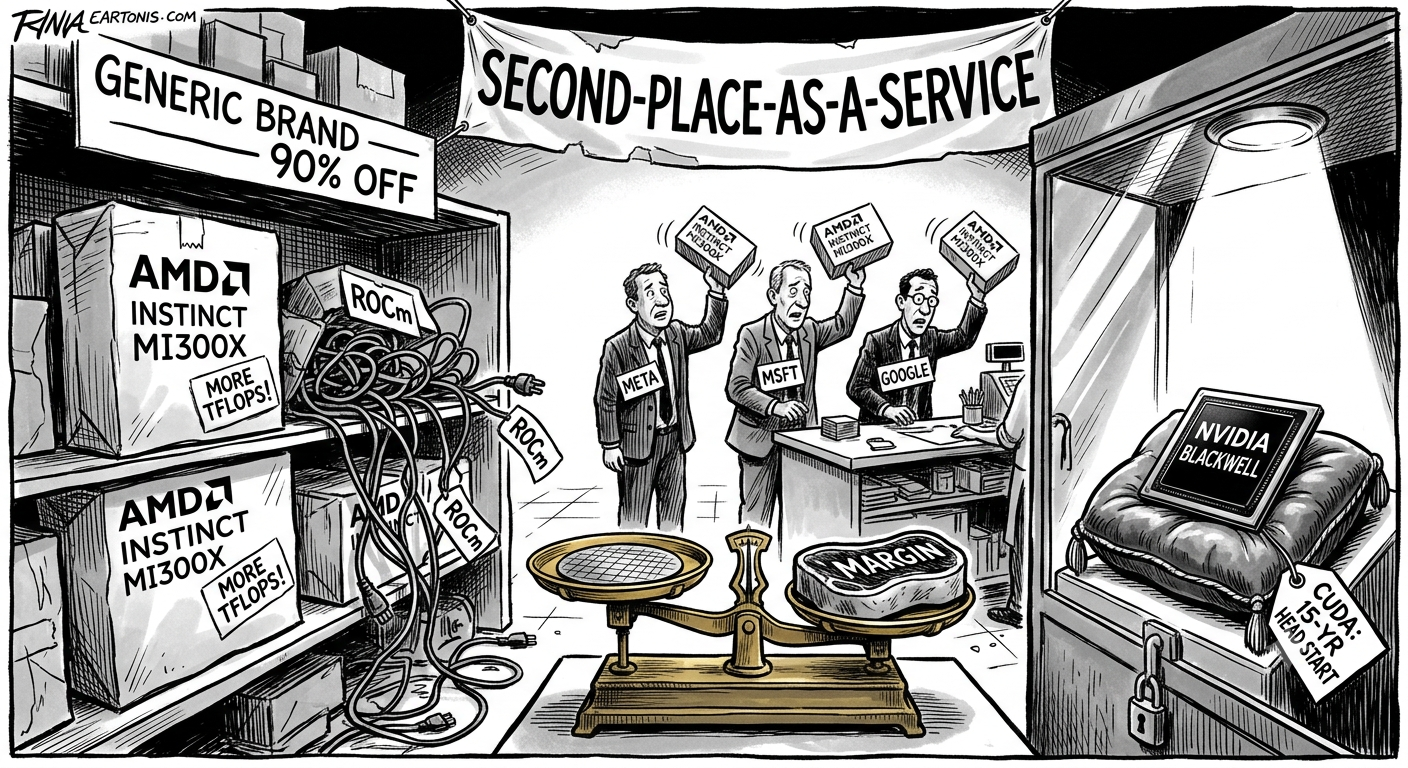
There is a highly specific, desperate flavor of marketing spin that only occurs when a company realizes it is trapped in permanent second place. Advanced Micro Devices' sudden, deeply emotional devotion to the open-source community isn't altruism; it's a brilliant PR camouflage designed to hide a massive software R&D deficit.
1. The Generic Brand with Better "On-Paper" Specs
AMD loves to talk about the raw muscle of their Instinct MI300X and MI325X accelerators. They will happily show you charts proving they have more memory capacity and higher theoretical compute speeds than Nvidia.
But this is the classic generic-brand trap. It's the off-brand smartphone that boasts a 200-megapixel camera on the box, but when you turn it on, the software lag makes the photos look like they were taken with a toaster. Because Nvidia's proprietary software stack (CUDA) has a fifteen-year head start, real-world workloads utilize almost 90% of Nvidia's peak capacity. AMD's software platform, ROCm, is so historically unoptimized that the chips plateau early, leaving developers to access only a fraction of that "brutal on-paper" power. Claiming your hardware is better because of theoretical specs is like boasting your sports car can go 300 mph while missing three wheels and a transmission.
2. Crowdsourcing as a Philanthropy Strategy
When you don't have the budget or the engineering army to build a proprietary software ecosystem that actually works, you do the next best thing: you make it "Open Source" and pretend you're doing it for the good of humanity.
AMD pitches ROCm as the benevolent, open antidote to Nvidia's closed-source corporate monopoly, wanting the market to view them as freedom fighters. In reality, this is the corporate equivalent of buying a house that is completely gutted, inviting your friends over for a "renovation party," and telling them they should be grateful for the opportunity to give you free labor.
The ultimate irony of this strategy was best articulated by OpenAI CEO Sam Altman, who bluntly noted that OpenAI has been on the "wrong side of history" concerning open source.
When even the king of closed-source commercial AI admits the landscape shifts around open collaboration, it highlights the desperate nature of AMD's posture. AMD isn't championing open software out of the goodness of their heart or a visionary philosophical alignment; they are doing it because they need the global developer community to fix their broken code for free. It is a massive engineering shortfall wrapped in a virtue-signaling bow.
3. The Hyperscaler Betrayal (The Fake Friends)
Wall Street's ultimate beef with AMD isn't even about the chips; it's about their clientele. AMD loves to brag about major cloud providers and hyperscalers buying up their hardware.
But let's look at why these tech giants are flashing cash at AMD. Meta, Microsoft, and Google don't actually want AMD to win. They have zero loyalty to the brand. Hyperscalers buy a baseline allocation of AMD chips to use as a terrifying negotiation tactic. The minute Nvidia tries to price their next-generation Blackwell racks too high, the cloud giants point to their pile of AMD Instinct chips and say, "Careful, or we'll buy more of the generic stuff." AMD isn't a premium partner; they are a compliance line-item and an insurance policy. The second Nvidia drops their prices by a fraction, those hyperscaler "friends" will drop AMD without a single backward glance.
The Anti-Trust Shield Matrix
| The Fallacy | The Corporate Spin | The Cold Ledger |
|---|---|---|
| Hardware Dominance | "Our chips have more memory and higher TFLOPS than the competition." | A massive performance deficit because the software stack can't coordinate the hardware. |
| Open-Source Altruism | "We are democratizing artificial intelligence through open ecosystems." | We are crowdsourcing our software development because we can't build a functional proprietary ecosystem. |
| Hyperscaler Validation | "Tier-one cloud providers are aggressively expanding their use of our platforms." | We are being used as a temporary pricing threat to scare Nvidia during contract renewals. |
AMD can host all the grand keynotes they want, boasting about their open software platforms and massive on-paper performance metrics. But Wall Street sees right through the luxury rebrand of a second-tier fallback option. They aren't building a paradigm; they are providing "Second-Place-As-A-Service," operating entirely on the short-term panic of cloud providers who just need a cheap tool to keep their main supplier honest.
Welcome to the Bargain Bin.
The Reality Check
To summarize the performance AMD is putting on to hide its enterprise gap, we can look to Shakespeare's cutting commentary on deceptive packaging:
"Thus ornament is but the guilèd shore
To a most dangerous sea; the beauteous scarf
Veiling an Indian beauty; in a word,
The seeming truth which cunning times put on
To entrap the wisest."— William Shakespeare, The Merchant of Venice, Act 3, Scene 2
References
[1] Advanced Micro Devices, Inc. — Q1 2026 Earnings & Data Center Performance Analysis.
[2] AIMultiple — "GPU Software for AI: CUDA vs. ROCm in 2026," Technical Deep Dive.
[3] Silicon Analysts — Data Center Architecture & Hyperscaler Capex Dynamics, April 2026.
[4] Sam Altman — "OpenAI Has Been On the 'Wrong Side of History' Concerning Open Source," February 2025 Statement.
[5] William Shakespeare — The Merchant of Venice, Act 3, Scene 2.
Note to the Lawyers: This is satirical commentary. All financial data is sourced from public earnings reports and technical analyses. Not investment advice.