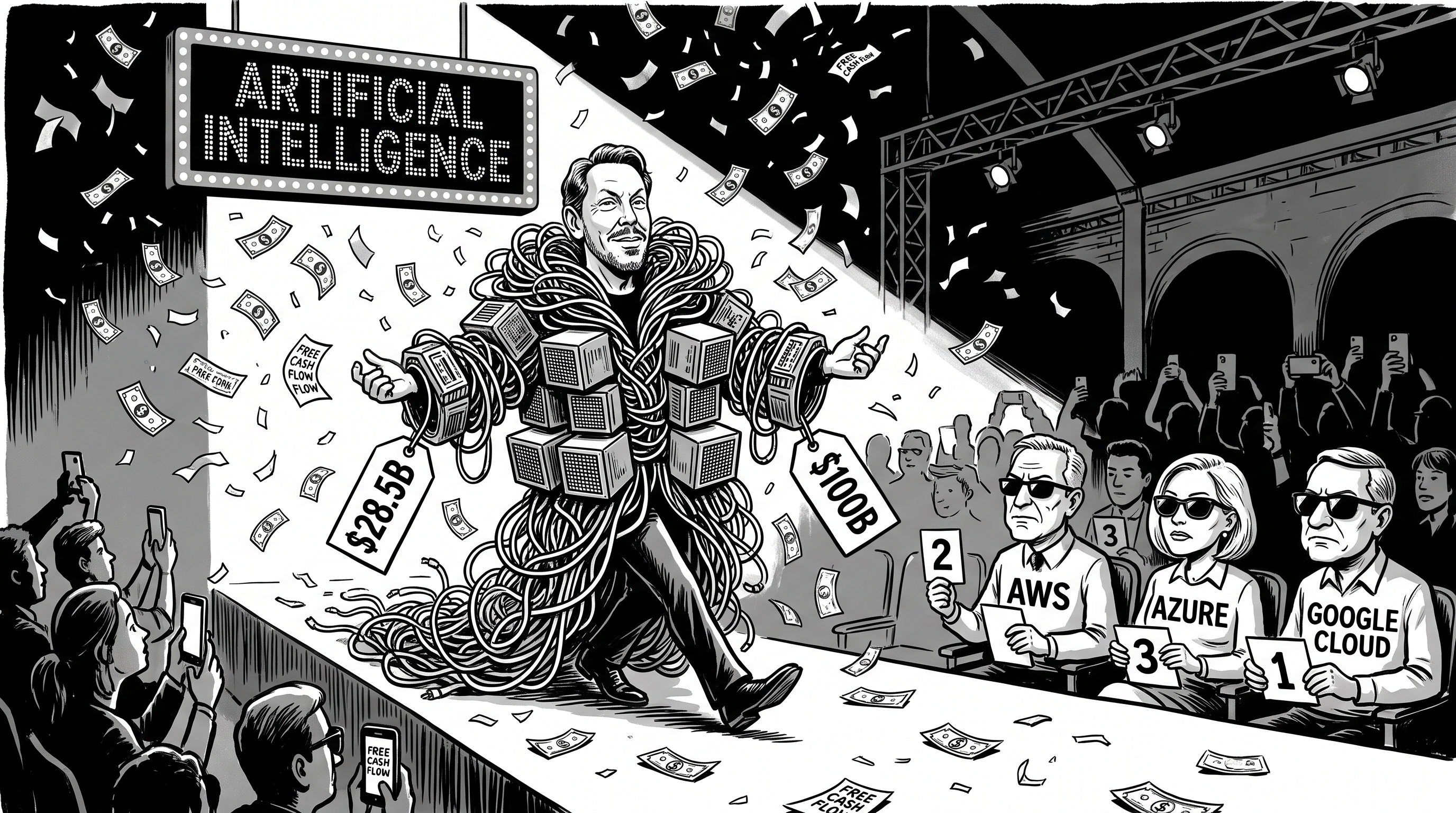
In the tech world, Silicon Valley's latest season is always dictated by whatever shiny new leather jacket Jensen Huang wears onto the runway, but haute couture has never lived in Redwood Shores. Nobody leaves Oracle on purpose. You don't buy Oracle software; you get sentenced to it by an IT architecture committee that retired fifteen years ago.
For four decades, Larry Ellison ran enterprise tech's most profitable shakedown. The playbook was simple: trap massive corporations in Byzantine database contracts, dispatch armies of compliance auditors to inspect every server they owned, and demand millions if they dared to breathe near an unmetered CPU core. Once an enterprise was hooked, Oracle charged an automatic 22% annual maintenance fee just to send standard software patches written by interns, minting obscene 80% to 85% gross margins on pure software rent [1]. It was never an operating model; it was a toll bridge built on customer migration terror.
Then came the modern pivot: Ellison realized Wall Street no longer awards tech multiples to medieval landlord bullying—unless you rebrand it with "Artificial Intelligence."
The Latest Earnings: Smoke, Mirrors, and Cash Fires
The stock surged on their latest Q1 FY27 report because automated headline algorithms only scan top-line percentages. But strip away the PR glaze, and the filing reads less like a tech triumph and more like a company setting its own balance sheet on fire:
- The $28 Billion Hardware Furnace: Management trumpeted a 121% year-over-year surge in Cloud Infrastructure (OCI) revenue to $7.4 billion and flashed an astronomical $664 billion backlog [2]. The receipt to buy that growth? A staggering $28.5 billion in capital expenditures in ninety days, putting Oracle on pace to burn nearly $100 billion this year alone [2, 3]. Oracle is now spending more on depreciating hardware in a single quarter than it used to invest in five years.
- Bleeding Pure Cash: Oracle used to be an unrivaled cash-compounding engine. Today, with hardware bills wildly outpacing operating cash generation, simple arithmetic takes over: Free Cash Flow plummeted to negative $5.4 billion for the quarter [3]. The software monopoly has successfully transformed itself into an unhedged power utility.
- Quietly Printing New Shares: To keep purchasing Jensen Huang's silicon without tripping rating-agency covenants on its crushing $125 billion debt load, Oracle quietly executed a $20 billion At-The-Market (ATM) equity offering [4]. While executive leadership preached unmatched AI dominance on the call, the treasury was flooding the secondary market with newly minted shares to fund the electric bill.
- Surrendering to Rivals: For years, Ellison swore OCI would demolish AWS and Azure. Today, his marquee narrative is "MultiCloud"—corporate double-speak for paying rack-rent inside Amazon, Microsoft, and Google datacenters just to prevent captive legacy customers from abandoning Oracle databases entirely [5].
Oracle hasn't discovered a bold new future. They took the world's most lucrative software tollbooth, traded it for a mountain of rapidly aging computer chips, and diluted their own shareholders to keep the server fans spinning.
Back in 2008, when Wall Street first pressured him to chase the emerging cloud bandwagon, Larry Ellison accidentally told the whole truth to a room of financial analysts [6]:
"The computer industry is the only industry that is more fashion-driven than women's fashion… Maybe I'm an idiot, but I have no idea what anyone is talking about. What is it? It's complete gibberish. It's insane. When is this idiocy going to stop? We'll make cloud computing announcements. I'm not going to fight this thing."
— Larry Ellison, 2008
Eighteen years later, Ellison proved he was right all along: he didn't fight the fashion cycle; he simply ordered $100 billion worth of runway outfits on his shareholders' credit cards.
References
1. Oracle Corporation Form 10-K filings, "Cloud Services and License Support" line items. Enterprise software licensing agreements standardly stipulate a baseline 22% annual technical support and update fee calculated on net perpetual software licenses.
2. Oracle Corporation Q1 FY27 Earnings Release (Quarter ended August 31, 2026; filed September 10, 2026) and CEO/CFO Prepared Remarks; noting $664B in Remaining Performance Obligations (RPO) and annual CapEx projections pacing toward $90B–$95B.
3. Oracle Corporation Q1 FY27 Condensed Consolidated Statements of Cash Flows. Gross additions to property, plant, and equipment ($28.45B) outpaced operating cash flows, resulting in a Free Cash Flow deficit of $(5.4B).
4. Oracle Corporation SEC Form 8-K and Prospectus Supplement (Equity Distribution Agreement for up to $20.0B of common shares, completed Q1 FY27); balance sheet leverage reflects total consolidated short- and long-term notes payable exceeding $120B–$125B.
5. Oracle Cloud Infrastructure partnership disclosures and rollout schedules for Oracle Database@Azure, Oracle Database@Google Cloud, and Oracle Database@AWS.
6. Larry Ellison remarks delivered at the Churchill Club Executive Speaker Series, San Jose, California (September 2008).
This is not financial advice. If you manage your money based on an essay comparing enterprise software to runway fashion, you deserve the margin call coming your way.
Nothing here is a recommendation to buy, sell, or short Oracle ($ORCL). The author holds zero shares, zero corporate debt, and zero sympathy for CIOs trapped in ten-year licensing contracts. Pandas look cute and cuddly right up until they chew through your balance sheet with 250 pounds of raw bear jaw-power.
Trade at your own peril, manage your own risk, and never borrow money to chase someone else's depreciating silicon.