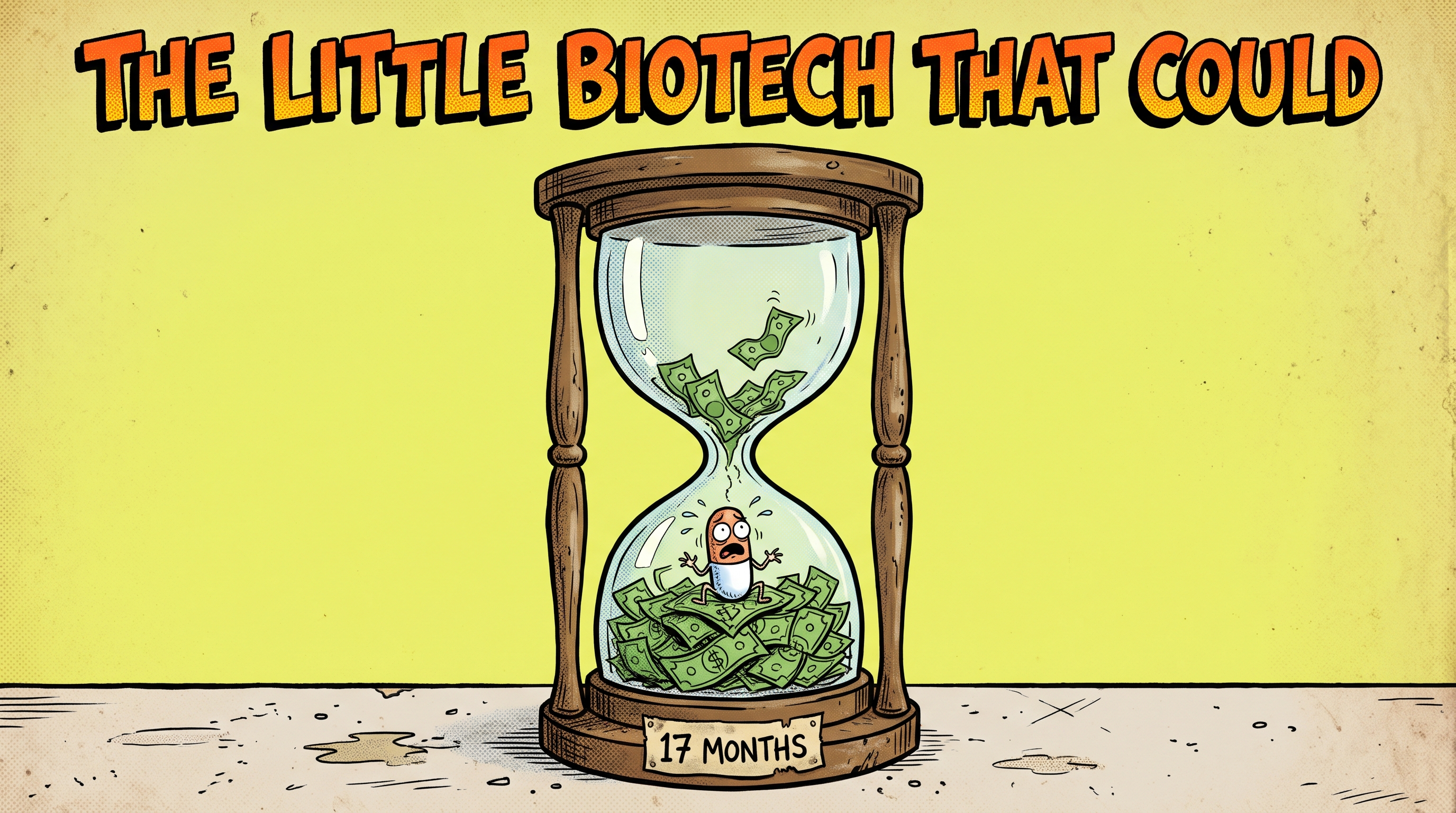
There is a special kind of biotech company that appears on Wall Street every few months. It has a brilliant scientist. A promising molecule. A beautiful investor presentation. A few million dollars of cash. And approximately seventeen months of runway.
Welcome to small biotech.
These companies are where the science can be most exciting and the financial structure can be most brutal.
A clinical-stage biotech may have no meaningful revenue. It may spend tens or hundreds of millions of dollars every year. That money goes into research, clinical trials, manufacturing, regulatory work and employees.
The company doesn't necessarily have a traditional business yet. It has an asset. Maybe one drug. Maybe a platform. Maybe a collection of early programs. The valuation is therefore based heavily on what those assets might become.
This creates a strange financial equation. The company needs cash to create the future. But creating that future consumes cash. So eventually the company needs more money.
This is where dilution enters the story. If a biotech sells new shares to raise capital, existing shareholders own a smaller percentage of the company. The company gets cash. The investor gets dilution.
Sometimes that is necessary. Sometimes it is painful. Usually it is both.
Then there are shelf registrations, follow-on offerings, private placements and convertible debt. The vocabulary can sound complicated. The basic question is simple:
How is this company going to pay for the next two years?
Cash runway is one of the most useful numbers in biotech. If a company has $300 million in cash and burns $100 million a year, the headline number is $300 million. The more useful number is approximately three years of runway, before considering changes in spending and other financing needs. If the company has $100 million and burns $100 million a year, the clock is much shorter. And the closer the company gets to needing money, the more financing risk matters.
This is why a good clinical result does not always mean a good stock reaction. Imagine a small biotech announces excellent Phase 2 data. The stock jumps. Then investors realize the company needs $250 million to fund Phase 3. Suddenly the financing becomes part of the story.
The science improved. The balance sheet did not.
Partnerships can change this. A larger company may pay an upfront fee and agree to fund development. That can extend the smaller company's runway and reduce dilution. Milestone payments can provide additional capital if development succeeds. Royalties can create future economics without requiring the small company to commercialize the drug itself. But again, the headline number is not the same thing as cash today.
Another important concept is the one-asset biotech. If the company has one major drug, then that drug is effectively the company. A Phase 3 failure can destroy most of the investment thesis. A successful trial can transform the company.
This is why small biotech can produce enormous percentage moves. The starting valuation is small. The uncertainty is large. The information arrives in chunks. A successful result can change the perceived probability of success dramatically. So can a failure.
Reverse splits are another recurring feature. When a stock falls far enough, a company may consolidate shares to meet exchange listing requirements or otherwise restructure its share price. A 1-for-10 reverse split doesn't magically create value. Ten old shares become one new share. The percentage ownership of the business does not magically improve. The share count changes. The stock price per share changes. The underlying economics are what matter.
This is why small biotech investors need to watch more than the pipeline. Watch the balance sheet. Watch the burn. Watch the share count. Watch financing. Watch debt. Watch partnerships. Watch milestones. And watch what happens if the lead asset fails.
Because the most important question for a tiny biotech is often not: "How big could this drug become?"
It is: "Can this company survive long enough to find out?"
That is the little-biotech paradox. The science may be early. The potential may be enormous. But the cash clock is already running.
References
- [1]U.S. Securities and Exchange Commission (SEC): 17 CFR 230.415 – Delayed or continuous offering and sale of securities. The rule underlying shelf registrations and at-the-market offerings.
- [2]U.S. Securities and Exchange Commission (SEC) / Investor.gov: How to Read a 10-K. Investor guide to the annual report, including financial statements, risk factors and going-concern disclosures.
- [3]Financial Accounting Standards Board (FASB): Accounting Standards Update 2014-15, Presentation of Financial Statements—Going Concern (Subtopic 205-40). Management’s obligation to evaluate and disclose substantial doubt about a company’s ability to continue operating.
- [4]Nasdaq: Listing Rules 5550(a)(2) and 5810(c)(3)(A) – Minimum bid price and reverse-split compliance. The $1.00 minimum bid requirement and the conditions under which a reverse stock split can cure it.
- [5]Biotechnology Innovation Organization (BIO) / Informa Pharma Intelligence / QLS Advisors: Clinical Development Success Rates and Contributing Factors 2011–2020 (2021). Historical probability of a drug moving from Phase 1 through approval.
- [6]SRS Acquiom / Fierce Biotech: Average biopharma biobucks decline, while upfront deal payments rise (Sept. 24, 2025). Analysis of how much of a headline biopharma deal value is paid upfront versus contingent on milestones.
Educational content, not financial advice. Structure Therapeutics is referenced in the companion scorecard only as an illustrative example of a clinical-stage biotech, not as a recommendation to buy, sell, or trade any stock.