There is a highly specific, desperate flavor of marketing spin that only occurs when a company realizes it can no longer Just Do It. When a corporate giant spends decades screaming Find Your Greatness, only to watch its stock price Just Drop It, you know the corporate engine has stalled.
1. The Heritage of Exploitation: From Sweatshops to Xinjiang
Nike's modern corporate spin portrays it as a beacon of progressive culture, athlete empowerment, and social justice. But Wall Street has a long memory, and the receipts tell a vastly less sanitized story.
Decades ago, Nike practically pioneered the dark art of the hyper-profitable supply chain by outsourcing its production to overseas factories plagued by systemic labor abuses, forced overtime, and abysmal wages. The brand spent the entire late 1990s dodging public relations nightmares, only to run face-first into the modern geopolitical woodchipper. More recently, the company faced severe scrutiny regarding its historical reliance on suppliers linked to forced labor and unethical cotton sourcing in the Xinjiang region. When a brand's foundational margin structure is historically subsidized by turning a blind eye to human rights deficits, the moral posture wears thin.
2. The Direct-to-Consumer Backfire
When you don't have the creative energy to design a shoe that people actually want to buy, you do the next best thing: you completely rewrite your distribution model and hope nobody notices the product stagnation.
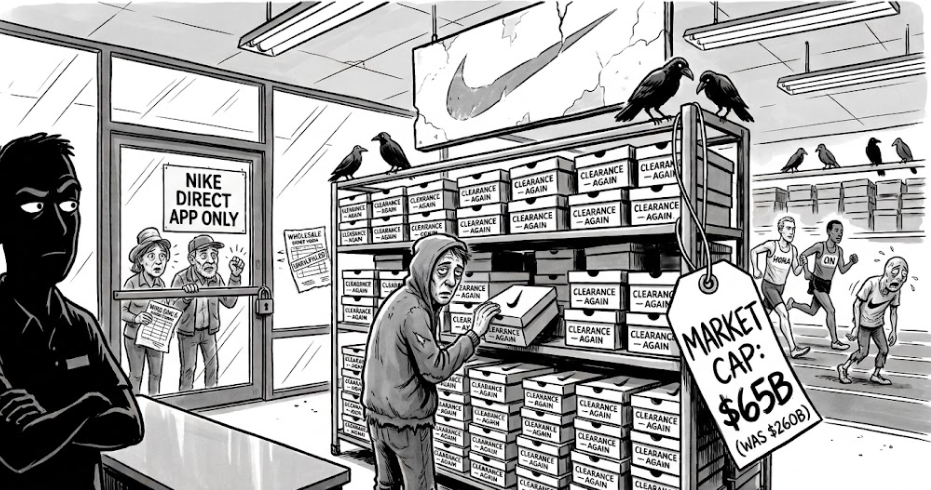
Under the guise of a high-tech digital revolution, Nike spent the early 2020s aggressively severing ties with its traditional retail partners — the very mom-and-pop shops and sporting goods ecosystems that built the brand. They wanted to force every consumer into the proprietary Nike Direct digital app, capturing 100% of the data and retail margins. In reality, this was the corporate equivalent of locking your front door and telling your neighbors they are only allowed to speak to you via a broken digital intercom. By mid-2026, the strategy completely imploded. Nike's digital revenue plummeted 12% in its latest filings, forcing management into a humiliating U-turn to beg wholesale distributors to take their stale inventory back.
3. The Ultimate Social Outcast: The Bargain-Bin Fallback
The true depth of Nike's crisis isn't found in their supply chain metrics; it is found on the feet of the public. Wearing a pair of Nikes was once the ultimate symbol of aspirational cool. Today, it identifies you as the uninspired consumer who settled for whatever was sitting on the clearance table.
Walk into any suburban outlet mall on a Saturday afternoon, and you'll witness the sad ritual of uninspired buying. A shopper shuffles past the fluorescent-lit racks, dead-eyed, picking up the same tired, white-and-black Dunk colorway they've seen a thousand times on TikTok. There's no excitement, no sense of discovery — just a dull, mechanical transaction driven entirely by the discount sticker. They buy it because it's there, it's cheap, and thinking of a more interesting brand requires too much effort.
Because Nike flooded their direct channels with these repetitive, uninspired retro line extensions, the premium scarcity vanished. The street-level culture that once defined the brand has completely moved on. Now, wearing those oversized swooshes makes you look like a walking mid-tier index fund, while specialized upstarts like Hoka and On Running are eating Nike's market share for breakfast.
4. The $195 Billion Erasure
The cold, quantitative ledger of this cultural bankruptcy is staggering. At its absolute peak in 2021, Nike was a financial titan boasting a market capitalization of over $260 billion. By mid-2026, that towering figure has violently eroded to a sobering $65 billion. Wall Street didn't just trim the fat; it executed a brutal, systemic re-pricing of a company that traded its premium innovation multiple for commodity margins. With credit agencies revising their outlooks to negative and billions of dollars in enterprise value evaporated into thin air, the swoosh has transformed from a symbol of structural dominance into an expensive warning label on a bleeding balance sheet.
Nike can launch all the star-studded advertising campaigns they want, trying to convince the world that their swoosh still carries the weight of a premium lifestyle asset. But the market sees right through the luxury veneer of a declining consumer staple. They aren't running a race anymore; they are running a liquidation sale, operating entirely on the hope that someone will buy their discount sneakers before the remaining brand cachet completely rots away.
Which begs the uncomfortable question: Can a brand engineered for the mass-market discount rack ever genuinely come back as 'Cool'? Or has the corporate machine expanded so wide that premium scarcity is permanently out of reach? Welcome to the Social Margin.
The $195B Question Matrix
| The Fallacy | The Corporate Spin | The Cold Ledger |
|---|---|---|
| Progressive Brand Image | "We champion athlete empowerment and social justice." | Decades of supply-chain scrutiny, from 1990s sweatshops to Xinjiang cotton sourcing. |
| Digital Revolution | "Nike Direct captures the full consumer relationship." | Digital revenue down 12%, wholesale partners begged to take stale inventory back. |
| Premium Lifestyle Asset | "The swoosh still commands aspirational cool." | Market cap fell from $260B to $65B as Hoka and On captured the culture. |
The Reality Check
By turning their premium asset into a commodity discount rack, Nike didn't just lose its margins; it lost its soul to the corporate flatterers — the tech platforms and the uninspired mass-market buyers who only love a brand when it's cheap. To deliver the final reality check on the corporate machine, we turn to the acidic wisdom of the original Cynic:
"It is better to fall among crows than flatterers; for those devour only the dead — these the living."
— Antisthenes
References
[1] Sheffield Hallam University: Murphy, L. et al., "Laundering Cotton: How Xinjiang Cotton Is Obscured in International Supply Chains," Helena Kennedy Centre for International Justice (November 2021).
[2] U.S. House Select Committee on the CCP: Official Congressional Inquiry Letter to Nike, Inc. regarding UFLPA Compliance and Uyghur Forced Labor Testimony (May 2023).
[3] Canadian Ombudsperson for Responsible Enterprise (CORE): Initial Assessment Report on a Complaint Filed Against Nike Canada Corp. (July 2023).
[4] NIKE, Inc. Official Disclosures: Statement on Forced Labor, Human Trafficking, and Modern Slavery; Fiscal Fourth Quarter and Full Year Results SEC Disclosures.
[5] S&P Global Ratings / Moody's Investors Service: Corporate Research Credit Updates and Long-Term Issuer Credit Downgrades / Outlook Adjustments.
[6] Diogenes Laërtius: Lives and Opinions of the Eminent Philosophers, Book VI (Antisthenes).
Note to the Lawyers: This is satirical commentary. All financial data is sourced from public earnings reports, SEC disclosures, and independently verified third-party research. Not investment advice.