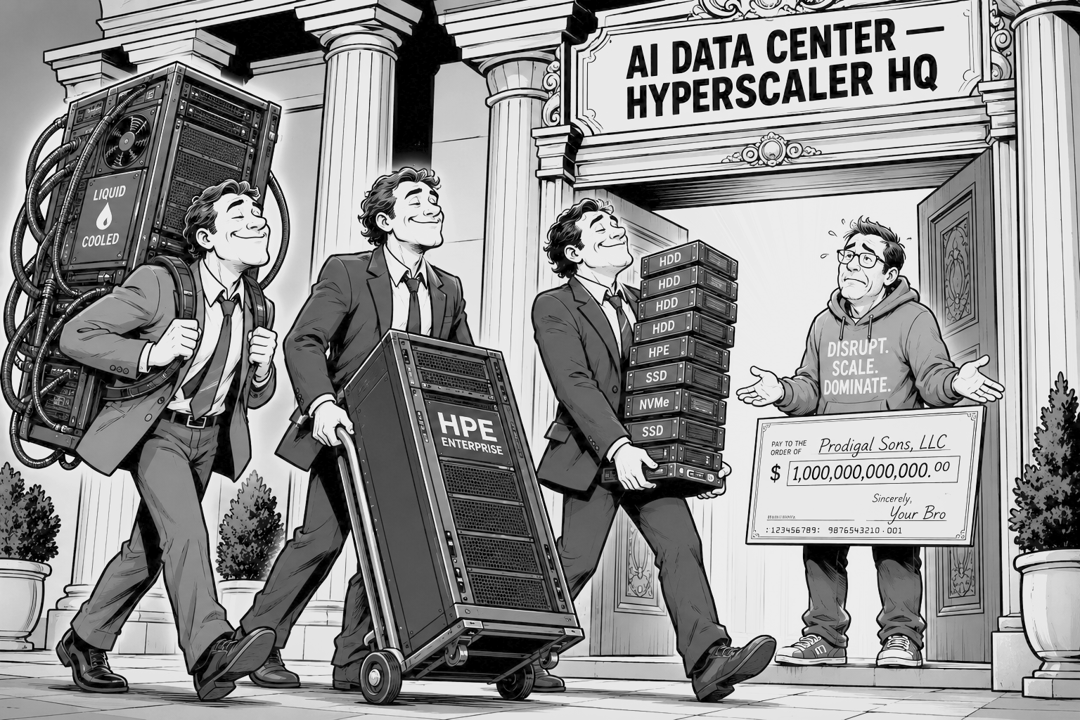
Once upon a time, the tech elite looked at the hardware layer of the S&P 500 and saw a depressing corporate retirement home. Wall Street analysts and retail degenerates alike dismissed them as "legacy relics." Buying Dell was what your dad did in 1998 when Michael Dell was still telling people they had a "built-to-order" future. Buying HPE was an exercise in corporate archaeology.
Holding Western Digital or SanDisk was a bet on the survival of spinning metal rust in an increasingly ethereal, cloud-first world.
These boys fell out of Wall Street's favour — unloved, faded, and entirely un-sexy.
Then came the generative AI gold rush. The hyperscalers realised something incredibly embarrassing: you cannot make an omelette without some chickens. You can't run an omniscient, god-like LLM on pure vibe. You need stuff — heavy metal stuff. You need memory sticks. You need massive, loud, power-hungry aluminium boxes.
So here's the return of the hardware prodigal sons. These boys returned to clean out the wallets of the Silicon Valley elite. And yes, how ostentatious they have made their arrivals.
1. Dell Technologies: Michael's Revenge
For years, Dell was the ultimate "PC guy" punchline. Wall Street treated it like a glorified distribution warehouse that accidentally got listed on the New York Stock Exchange. When it was re-added to the S&P 500 in late 2024, replacing Etsy, the poetic contrast was perfect: the market traded artisanal knit blankets for industrial-grade server racks.
But look at the latest filings. For Q1 Fiscal 2027 (ended May 2026), Dell didn't just beat expectations — they staged an absolute operational coup. Total revenue climbed to $43.8 billion, but the crown jewel was their Infrastructure Solutions Group. AI-optimised server revenue exploded by an eye-watering 757% year-over-year to $16.1 billion.
Michael Dell isn't just back; he's taking victory laps. When asked about the sustainability of this margins-diluting hardware crunch, he essentially told the market:
"The physical infrastructure layer isn't the bottleneck — it is the foundational constraint of human progress for the next decade."
Translation: You will buy my liquid-cooled boxes at whatever premium I demand, or your AI agent won't even know how to spell its own name. Dell is now sitting on a $51.3 billion AI backlog. The "PC maker" is now the gatekeeper of the AI data centre.
2. HPE: The Corporate Split That Actually Worked
When Hewlett-Packard split itself in half back in 2015, the general consensus was that HP Inc. got the dying printer business and HPE got the dying enterprise server business. For a decade, HPE was the ultimate value trap — boring corporate sales cycles to uninspiring enterprise IT departments.
Fast forward to their Fiscal Q2 2026 earnings from early June 2026. HPE reported total revenue of $10.7 billion, a thumping 40% year-over-year jump that shattered consensus estimates. Their server segment alone brought in $7.7 billion, fuelled entirely by insatiable enterprise demand for AI clusters.
CEO Antonio Neri dropped the ultimate mic-drop line for a legacy hardware business:
"The inflection point we are witnessing has effectively advanced our structural enterprise roadmap by two full fiscal years."
They are living in 2028 while the market is still trying to figure out if enterprise AI is a fad. HPE went from legacy vendor to sovereign AI infrastructure necessity. The cloud isn't some magical ether — it's just someone else's incredibly expensive HPE server on wheels.
3. Western Digital: The Return of the Memory Lords
If Dell and HPE are building the brains, Western Digital is providing the permanent memory. For years, WDC was the epitome of a brutal, cyclical commodity business. Wall Street dismissed them so hard they forgot WDC actually swallowed SanDisk whole back in 2016 for $19 billion.
But the AI narrative has triggered a massive, structural storage supercycle. Turns out, when you have millions of autonomous AI agents hallucinating petabytes of data every single second, you need somewhere to dump the files.
In their Q3 Fiscal 2026 results, WDC posted a spectacular 45.5% year-over-year revenue surge to $3.34 billion, while engineering a massive expansion of non-GAAP gross margins past 50%. They even hiked their dividend by 20% just to gloat.
WDC went from the bargain bin of the tech sector to the ultimate toll-booth on the data highway.
The Legacy-to-AI Valuation Matrix
| Ticker | Legacy Reputation | AI Reality | Q1/Q2 2026 Headline |
|---|---|---|---|
| DELL | "Dude, you're getting a corporate desktop." | The undisputed king of liquid-cooled AI server clusters. | $16.1B AI Server Revenue (+757% YoY) |
| HPE | Splintered, slow-moving enterprise IT dinosaur. | Sovereign AI cloud provider operating two years ahead of schedule. | $10.7B Total Revenue (+40% YoY) |
| WDC | Volatile, low-margin cyclical spinning-disk manufacturer. | The absolute baseline storage toll-booth for hyperscale data centres. | 50%+ Gross Margins (Storage supercycle) |
Wall Street spent five years chasing abstract software-as-a-service multiples, completely forgetting that software requires physical reality to exist. The prodigal hardware sons didn't change their business models; the world simply ran out of computational space and had to crawl back to the guys who actually know how to bend sheet metal and solder memory chips.
Data Sources
[1] Dell Technologies (DELL) — Q1 Fiscal 2027 Earnings Release and SEC Form 10-Q (period ended May 2026). $43.8B total revenue, $16.1B AI-optimised server revenue (+757% YoY), $51.3B AI backlog.
[2] Hewlett Packard Enterprise (HPE) — Q2 Fiscal 2026 Financial Results (reported June 2026). $10.7B total revenue (+40% YoY), $7.7B server segment revenue.
[3] Western Digital (WDC) — Q3 Fiscal 2026 Earnings Report. $3.34B revenue (+45.5% YoY), non-GAAP gross margins exceeding 50%, dividend hiked 20%.
[4] S&P Dow Jones Indices — Structural index adjustment confirming removal of Etsy and re-inclusion of Dell Technologies into the S&P 500 (late 2024).
Note to the Lawyers: This is satirical commentary. All financial data is sourced from public earnings releases and SEC filings. Not investment advice. If you bought Dell in 1998 because of this article, we are not responsible.