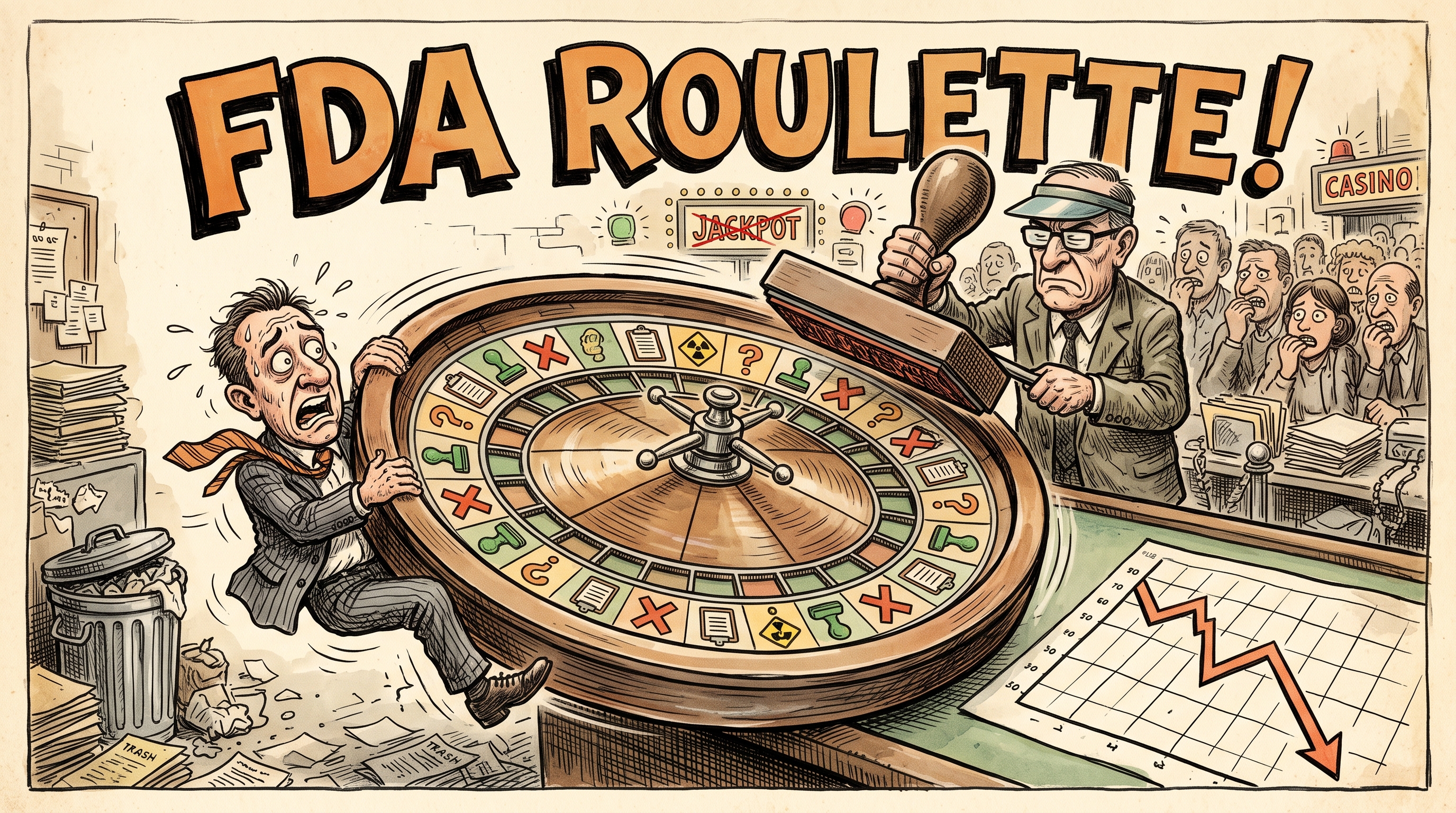
Biotech investors love one thing almost as much as a miracle drug.
A date.
- FDA decision.
- Clinical-trial readout.
- Advisory committee.
- PDUFA date.
The closer the date gets, the more the stock starts behaving like it has somewhere to be.
Welcome to FDA roulette.
Drug development is a sequence of increasingly expensive attempts to answer increasingly important questions.
Then comes the regulatory submission.
And eventually, the FDA has to decide whether the evidence supports approval for the proposed use.
The important word is evidence.
The FDA isn't grading the company's presentation.
It is reviewing the data.
This is why biotech stocks can move violently around clinical results.
A company may be worth hundreds of millions of dollars before a Phase 2 readout.
Then the data arrive.
If the result is substantially better than expected, investors may suddenly believe the probability of success has increased.
If the result is weak, the opposite can happen.
The company's laboratory hasn't necessarily disappeared.
The stock's expected future cash flows have.
That is the binary-event problem.
The stock is not simply pricing today's cash.
It is pricing the probability of tomorrow's drug.
This is why investors obsess over endpoints.
- What exactly was the trial designed to demonstrate?
- Did the drug hit the primary endpoint?
- Was the effect statistically significant?
- Was the effect clinically meaningful?
- What happened to safety?
A headline saying "positive results" can conceal an enormous amount of detail.
And then there are statistical questions.
A p-value can tell you about the probability of observing data this extreme under a particular statistical assumption.
It does not tell you that the drug is good.
It does not tell you the drug will become a blockbuster.
And it certainly does not tell you what the stock should be worth.
Biotech investors also need to understand the FDA calendar.
A PDUFA date is the target action date associated with an FDA review.
Advisory committees can be convened for certain products or questions.
The committee's recommendation can matter.
But it is not itself the final FDA decision.
Then there are Complete Response Letters.
A CRL means the FDA has determined that the application cannot be approved in its current form.
That does not always mean the drug is dead.
The company may need additional analysis, manufacturing work, another study or other action.
There are also accelerated approvals, label expansions and clinical holds.
Each changes the story.
A clinical hold can stop a trial from proceeding.
A label expansion can dramatically increase the addressable market for an already approved medicine.
Accelerated approval can allow certain serious conditions to receive earlier access based on surrogate endpoints, with confirmatory requirements.
This creates another important lesson.
The FDA event is only one piece of the investment equation.
Traders often treat the date itself as the event.
Long-term investors need to understand what the event actually changes.
A positive FDA decision does not automatically make a stock cheap.
A rejection does not automatically make a company worthless.
And a successful trial does not guarantee commercial success.
Ask CRISPR Therapeutics.
The technology won a Nobel Prize. The company won an FDA approval in December 2023. The gate opened, the stamp landed, and the press releases were magnificent.
Two and a half years later, its drug, CASGEVY, sold $76 million in a quarter, split with its partner. The company's own revenue line for that quarter read $10.2 million.
The approval was real. So was the cash register. It just rings very, very slowly.
Now compare that with Medtronic.
$36.4 billion in revenue last fiscal year. Four businesses. Heart devices, brain devices, surgical tools, diabetes.
It has had its own spin at the wheel. Its renal denervation device treats high blood pressure. An early pivotal trial failed to beat a sham, which is a fake procedure. An FDA advisory panel was split on whether the benefits outweighed the risks.
The FDA approved it anyway, on November 17, 2023.
Devices follow a different FDA pathway from drugs, but a gate is a gate.
The difference is what happens next. For a company this diversified, one approval is a line item. For a one-drug company, it is the company.
- The drug still has to be manufactured.
- Doctors still have to prescribe it.
- Patients still have to use it.
- Payers still have to pay.
- Competitors still exist.
- Patents still expire.
But before any of that happens, the biotech has to get through the gate.
That is why clinical development creates such strange stock charts.
The company can spend years doing science.
The market can spend months debating expectations.
Then one morning, a press release arrives.
And the entire valuation changes before breakfast.
That is biotech.
Next issue: what happens when Wall Street decides one kind of medicine is the future.
References
- [1]U.S. Food and Drug Administration (FDA): The Drug Development Process. Plain-language walkthrough of discovery, preclinical research, Phases 1–3 and FDA review.
- [2]U.S. Food and Drug Administration (FDA): PDUFA VII: Fiscal Years 2023–2027. Prescription Drug User Fee Act review performance goals, including target action dates.
- [3]U.S. Code of Federal Regulations: 21 CFR 314.110 – Complete response letter to the applicant. The regulatory definition of a complete response letter and what it means for an application.
- [4]U.S. Food and Drug Administration (FDA): Guidance for Industry: Expedited Programs for Serious Conditions. Accelerated approval, surrogate endpoints and confirmatory-trial requirements.
- [5]U.S. Code of Federal Regulations: 21 CFR 312.42 – Clinical holds and requests for modification. When and why the FDA can halt or restrict a clinical investigation.
- [6]Wasserstein, R. L. & Lazar, N. A.: The ASA Statement on p-Values: Context, Process, and Purpose. The American Statistician, 70(2), 2016. What a p-value does and does not tell you.
- [7]CRISPR Therapeutics AG: Business Update and Second Quarter 2026 Financial Results (Aug. 2026). CASGEVY revenue for the quarter, company collaboration revenue, net loss and cash position.
- [8]Medtronic plc: Reports Fourth Quarter and Full Year Fiscal 2026 Results (Jun. 3, 2026). Full-year revenue by segment: Cardiovascular, Neuroscience, Medical Surgical and Diabetes.
- [9]TCTMD: Symplicity Spyral Approved: FDA Clears Second Renal Denervation System (Nov. 2023). FDA approval of Medtronic’s renal denervation device after an early failed pivotal trial and a divided advisory panel.
- [10]MedTech Dive: Medtronic wins FDA approval for Symplicity renal denervation device (Nov. 20, 2023). Report on the approval and the advisory panel’s mixed views on effectiveness and benefit-risk.
Educational content, not financial advice. CRISPR Therapeutics and Medtronic are referenced here only as illustrative examples of a one-drug company and a diversified company facing FDA decisions — not as recommendations to buy, sell, or trade any stock, and no price target or forward return is implied for any company named.