Welcome to the most exotic wing of the public markets, where an enterprise can report precisely zero revenue, incinerate $300 million of equity capital a year, employ eighty PhDs in matching fleece vests, and still command a $4 billion market capitalization.
No, this isn't an overdue obituary for Silicon Valley enterprise SaaS.
This is biotechnology: the only sector on earth where basic human biology, corporate desperation, and blind speculative greed are shoved into a high-speed blender. Sometimes the concoction yields a generational medicine that saves lives. Frequently, it yields an eighty-million-dollar chemical spill in Phase 2. And almost always, it leaves behind an equity chart that resembles a grand piano being dropped down an elevator shaft.
Everyday equity analysts like to pretend they are assessing businesses. When you evaluate a supermarket chain, there is a physical plant: customers shuffle through the automatic doors, scan cereal boxes, and hand over legal tender. You can audit the inventory, count the registers, and verify the operating margin. When you look at software, you can count enterprise seats. When you look at an automaker, you can kick the tires on the assembly line.
When you buy a clinical-stage biotech stock, you are buying an unfunded philosophical question:
Does this proprietary synthetic molecule cure pathology in a human, or does it merely generate interesting liver toxicity?
If the answer is yes, congratulations: you own a future commercial monopoly. If the answer is no, you are the proud fractional owner of twelve pipettes, a lease on a wet lab in Cambridge, Massachusetts, and an eight-year tax-loss carryforward.
Naturally, Wall Street insists on pricing both outcomes every single morning at 9:30 AM.
The Clinical Funnel: An Expensive Elimination Tournament
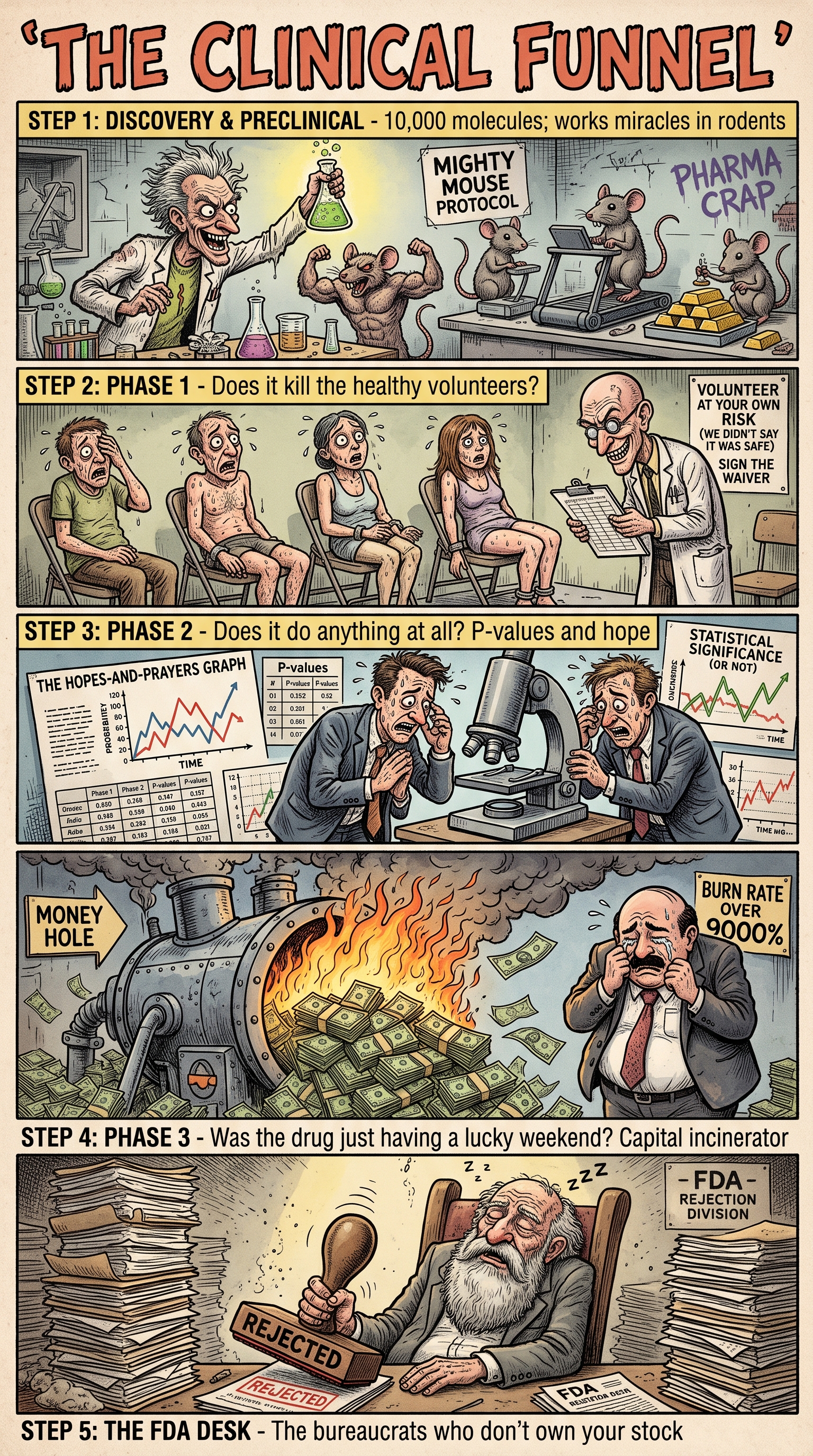
The transition from a pipette to a pharmacy shelf is not an orderly industrial process; it is an elimination contest designed to incinerate balance sheets.
The industry's promotional slide decks will describe the pipeline as a predictable, multi-stage regulatory progression. Thousands of chemical compounds start at discovery. The herd thins with brutal efficiency.
First, the asset must survive in vitro and preclinical models. Then comes Phase 1, where the compound is administered to actual human beings to answer a remarkably low-bar question: can a patient ingest this without immediate multi-organ failure? This is not the phase where retail investors order Gulfstreams; it is merely where the toxicologists verify that the trial cohort doesn't spontaneously combust.
Then comes Phase 2, where things get theatrical. The company must answer the uncomfortable follow-up: does this compound appear to alter the target disease?
Suddenly, generalist retail investors who spent the preceding fiscal year pretending they understood SaaS retention metrics are furiously searching the internet for terms like "primary endpoints," "progression-free survival," and "two-tailed p-values." A single press release citing an ambiguously met surrogate endpoint can send an equity up 140% before the market opens. An equivocal safety readout can wipe out the equity before the morning coffee cools.
Then comes Phase 3: the multi-hundred-million-dollar gauntlet. Large cohorts, international trial sites, clinical research monitors, and millions in legal overhead. This is where the company attempts to prove that its encouraging Phase 2 data wasn't just a statistical fluke or an aggressive exercise in post-hoc subgroup analysis.
And at the end of this journey sits the Food and Drug Administration.
The Bureaucracy That Does Not Care About Your Call Options
Executives want regulatory approval to monetize their stock options. Shareholders want regulatory approval so they can offload their shares onto the next cohort of hopefuls.
The FDA, meanwhile, cares only about one bureaucratic question: does the clinical evidence demonstrate that the therapeutic benefits outweigh the known toxicities for the indicated population?
These are three fundamentally incompatible objectives.
When the FDA approves a drug, analysts feverishly build twenty-year discounted cash flow models. When the FDA issues a Complete Response Letter rejecting the application, those same analysts delete the coverage model by lunch, leaving the CEO to deliver the standard corporate eulogy: "The Board has initiated a comprehensive review of strategic alternatives."
In the corporate world, those words are the functional equivalent of reading the last rites over a dying bank account.
The Hall of Mirrors: Valuing the Revenue-Free Mirage
Consider the everyday clinical-stage balance sheet:
- Cash and Equivalents: $400 million.
- Annual Net Cash Burn: $180 million.
- Commercial Revenue: $0.00.
- Implied Enterprise Value: $2.8 billion.
How does the sell-side justify that valuation? Through pure financial narrative:
The moment the variable "Probability" enters the calculation, corporate governance evaporates and creative storytelling takes over.
The most common sleight of hand in healthcare equity presentations is The TAM Illusion. A pitch deck prominently features a slide labeled: "$25 Billion Total Addressable Market."
The casual observer reads that slide and assumes the company is on the precipice of generational wealth. The company does not own that market. It does not even own the lint in the pockets of that market.
To turn that theoretical addressable market into actual cash flow, a long sequence of dominos must fall without a single disruption:
- The molecule must not kill patients in Phase 3.
- The regulators must sign off without demanding an extra three-year post-marketing safety trial.
- The chemistry, manufacturing, and controls (CMC) validation must pass without contaminating the bioreactors.
- Commercial insurers and pharmacy benefit managers must agree to reimburse the therapy instead of forcing patients onto a twelve-dollar generic alternative.
- Specialized physicians must be persuaded to abandon their existing clinical routines to write the prescription.
- And all of this must occur before the patent clock arrives, opening the gates to generic manufacturers.
When a biotech company tells you they are addressing a $25 billion market, the question is not "how much cash will they print?" The question is: "what miraculous combination of clinical, regulatory, and commercial events must occur simultaneously for them to capture even two percent of it?"
The Two Faces: Monopolies vs. The Platform Trap
To understand the lifecycle of biotech capital, look at the two polar extremes of the modern pharmaceutical spectrum: Eli Lilly and Moderna.
| Eli Lilly: The Commercial Leviathan | Moderna: The Platform Mirage |
|---|---|
| $65B+ in annual top-line revenue | Scaled on emergency pandemic demand |
| Mounjaro & Zepbound drive >50% of mix | Revenue fell from $6.8B to <$2B |
| The engine: execute, defend, replace | R&D burn remains relentless (>$3B) |
| Core question: What replaces the asset before the patent expires? | Core question: When does the platform produce the next actual product? |
Eli Lilly is what happens when a drug runs the gauntlet, beats the regulators, wins reimbursement, and becomes an economic juggernaut. In 2025, Lilly posted over $65 billion in revenue, with its incretin franchise (Mounjaro and Zepbound) pulling in more than $36 billion alone.
That is what an approved, scaled blockbuster looks like. But Big Pharma operates on a conveyor belt. The challenge for a mega-cap drugmaker is not simply finding a multibillion-dollar compound; it is finding the next multibillion-dollar compound before the current cash cow's patent expires and the revenue evaporates.
Moderna, on the other hand, illustrates the platform reality.
During the pandemic, its mRNA architecture went from a theoretical venture-backed platform to the center of global healthcare. Capital cascaded into the stock. But when emergency demand receded, revenue contracted from $6.85 billion in 2023 to under $2 billion in 2025 — all while the company continued to burn upwards of $3 billion annually in R&D to fund its pipeline.
The platform pitch sounds compelling: "We did not develop a mere drug; we built an engine that designs endless therapies."
The market's eventual reaction is always the same: "Splendid. Show us the commercial revenues from the next one."
An elegant discovery platform is an intellectual achievement; it is not, by default, an accretive commercial business. Biotech investors usually learn that distinction after paying tuition via a 60% drawdown.
The Three Independent Realities
To survive analyzing this sector, you must permanently isolate three distinct questions that market participants routinely confuse:
- Does the science work? Is the biological mechanism defensible, or is it an artifact of p-hacking and hopeful mice?
- Does the business work? If approved, can the company manufacture the therapy at scale, force commercial insurers to pay for it, and defend its intellectual property against patent challenges?
- Does the stock work at this valuation?
This third question is where most market participants get wiped out. A revolutionary therapy can be an abysmal investment if the prevailing equity price already demands five years of flawless commercial execution. Conversely, an unremarkable mid-cap developer can double in an afternoon if expectations were so thoroughly depressed that a mediocre trial readout looks like a triumph.
The market does not reward medical utility. It rewards reality outperforming expectations.
The Order Book
Biotech is not a pure roulette wheel: the clinical data is gathered through structured protocols, scrutinized by biostatisticians, and vetted by regulators.
The casino emerges the moment that clinical data is converted into an equity ticker:
- The investigator asks: Does the molecule demonstrate efficacy?
- The physician asks: Does this improve patient outcomes over standard of care?
- The regulator asks: Does the safety-to-benefit ratio justify formal approval?
- The CEO asks: Can we raise a $150 million secondary offering before the cash runway hits four months?
- The institutional desk asks: What is the risk-adjusted net present value?
- And the retail momentum trader asks: Can this squeeze 40% on an out-of-the-money options gamma ramp by Friday?
Every participant is staring at the exact same clinical assay. Not one of them is playing the same game.
The science provides the premise. The regulatory agency provides the gate. The company attempts to construct a business. And Wall Street packages it into a narrative. Sometimes the narrative is visionary. More often, it is an expensive hallucination backed by a glossy 50-slide PDF and a multi-billion-dollar enterprise valuation.
Welcome to biotech. Next week, we track the journey of the asset itself — from a compound frozen in a lab vial to an overpriced box sitting in a refrigerated supply chain.
References
- [1]U.S. Food and Drug Administration (FDA): The Drug Development Process (Step 1: Discovery & Development, Step 2: Preclinical Research, Step 3: Clinical Research, Step 4: FDA Drug Review, Step 5: Post-Market Safety Monitoring). Code of Federal Regulations Title 21 CFR Part 312 & 314.
- [2]Biotechnology Innovation Organization (BIO) / Informa Pharma Intelligence: Clinical Development Success Rates and Contributing Factors. Historical cumulative probability of clinical advancement from Phase 1 through FDA approval averages under 10% across all therapeutic modalities.
- [3]Eli Lilly and Company: Annual Report & Form 10-K Filing / Full-Year Financial Results. Incretin franchise performance disclosures, including consolidated product revenue for Mounjaro (tirzepatide injection for type 2 diabetes) and Zepbound (tirzepatide injection for chronic weight management).
- [4]Moderna, Inc.: SEC Form 10-K Annual Reports & Quarterly Financial Earnings Releases. Multi-year revenue progression ($6.85B in FY2023 transitioning to under $2.0B post-pandemic product demand contraction) versus persistent R&D expense allocations exceeding $3.0B annually across ongoing mRNA platform pipeline development.
Educational content, not financial advice. Eli Lilly and Moderna are referenced here only as illustrative case studies contrasting an approved commercial blockbuster against an early-platform business model — not as recommendations to buy, sell, or trade either stock, and no price target or forward return is implied for any company named.