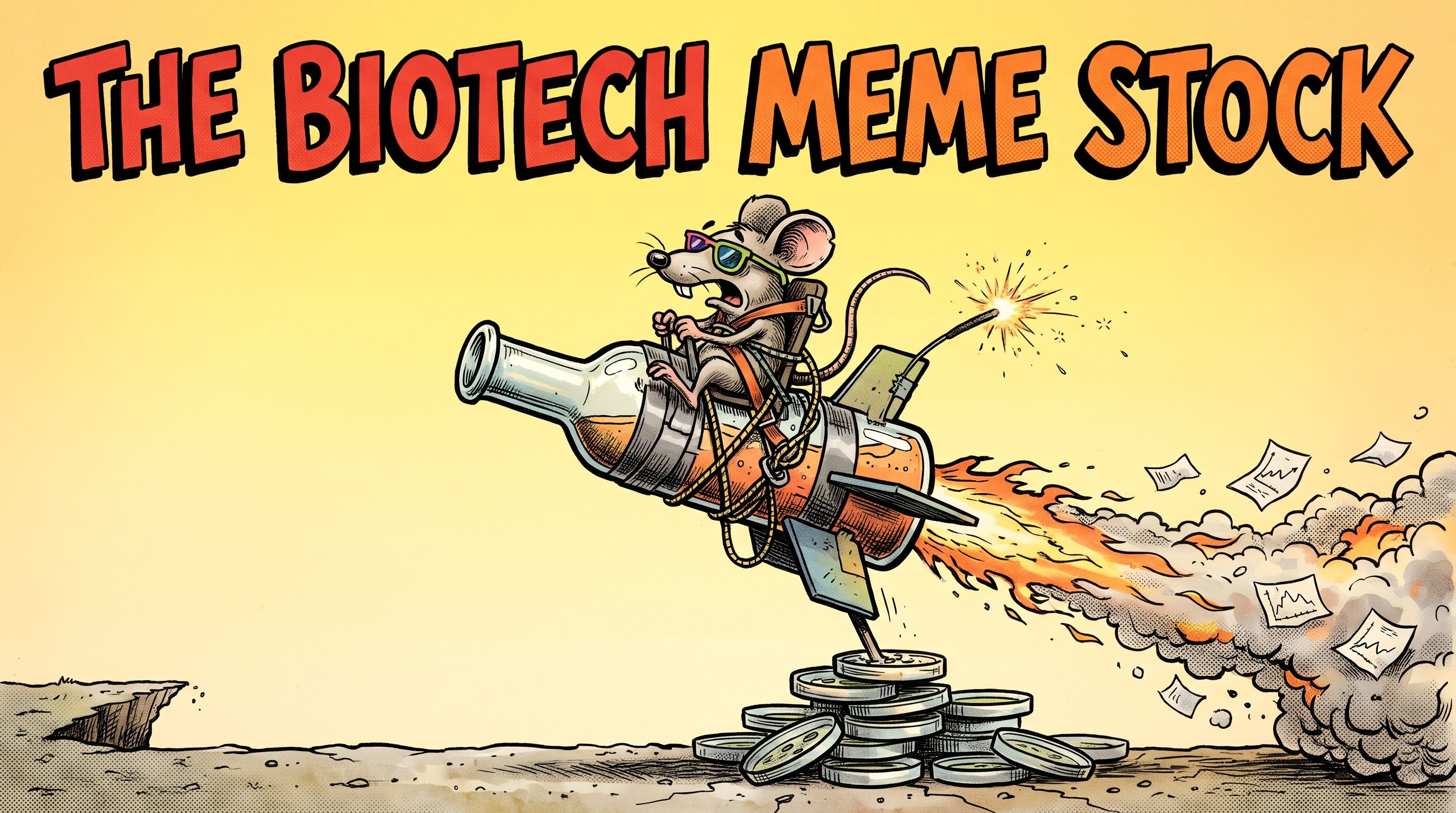
Biotech was practically designed by nature to become a meme.
Think about the ingredients.
Tiny companies. Huge promises. Binary events. Short interest. Options. FDA dates. Clinical-trial screenshots. Anonymous internet experts.
And a community willing to type:
"🚀🚀🚀" before breakfast.
The meme-stock era didn't invent biotech speculation. It simply gave it better distribution.
A biotech can become popular online because the story is incredibly easy to compress.
"Drug cures cancer."
"FDA decision Friday."
"Big Pharma wants it."
"30% short interest."
"Short squeeze incoming."
"Moon."
The actual science might require a 40-page clinical paper. The meme requires eleven words.
That is the problem.
A clinical catalyst creates a date. The date creates anticipation. Anticipation creates options activity. The price moves. Social media notices. More people notice. Suddenly the stock is famous.
And somewhere along the way, the original clinical data gets buried beneath screenshots of screenshots of screenshots.
This is where investors need to separate three things:
Speculation. Promotion. Manipulation.
Speculation is normal. People can make risky bets.
Promotion is also common. Companies, investors and influencers all have incentives to emphasize positive information.
Manipulation is different. It involves deceptive or otherwise unlawful conduct designed to distort a market.
Not every enthusiastic investor is a manipulator. Not every dramatic move is a short squeeze. Sometimes a stock rises because the clinical data genuinely surprised the market. Sometimes it falls because the data were genuinely terrible. Sometimes options positioning amplifies the move. Sometimes traders simply pile into the same story.
Short interest gets particular attention because heavily shorted stocks can experience additional buying if unexpectedly positive news forces short sellers to close positions.
Options can add another layer of fuel.
But none of this changes the underlying science.
A short squeeze can change the stock price.
It cannot change a failed Phase 3 endpoint.
That distinction gets lost surprisingly often.
The other danger is promotional language.
"Breakthrough." "Revolutionary." "Best-in-class." "Game-changing." "Multi-billion-dollar opportunity."
These phrases aren't automatically meaningless. But they aren't clinical endpoints either.
A serious biotech analysis eventually has to leave social media and return to the boring stuff:
Clinical-trial results. Regulatory filings. Cash. Debt. Share count. Patents. Competitors.
That is where the story either survives or dies.
And this is why biotech is such fertile ground for online speculation. The industry naturally produces suspense. There is a drug. There is a trial. There is a date. There is a stock. Everyone wants to know what happens next.
The internet simply turns that uncertainty into content.
The trick is remembering that viral is not the same thing as validated.
Eventually, every biotech meme stock faces the same question:
What happens when the meme meets the data?
Sometimes the answer is spectacular.
Sometimes the stock chart becomes the next exhibit in the biotech graveyard.
References
- [1]U.S. Securities and Exchange Commission (SEC): Investor Alert: Don’t Trade on Pump-and-Dump Stock Emails. How pump-and-dump promotions work and how investors get hurt
- [2]U.S. Securities and Exchange Commission (SEC): Investor Bulletin: An Introduction to Short Sales. How short selling works and why short positions are closed out
- [3]U.S. Securities and Exchange Commission (SEC): Staff Report on Equity and Options Market Structure Conditions in Early 2021. Review of the early-2021 meme-stock episode, including short interest and options activity
- [4]U.S. Securities and Exchange Commission (SEC) / Investor.gov: Social Media and Stock Tip Scams. Investor guidance on trading decisions driven by social media
Educational content, not financial advice. Novavax and Capricor Therapeutics are referenced only in the companion scorecards as illustrative examples of a vaccine biotech and a clinical-stage biotech, not as recommendations to buy, sell, or trade any stock.