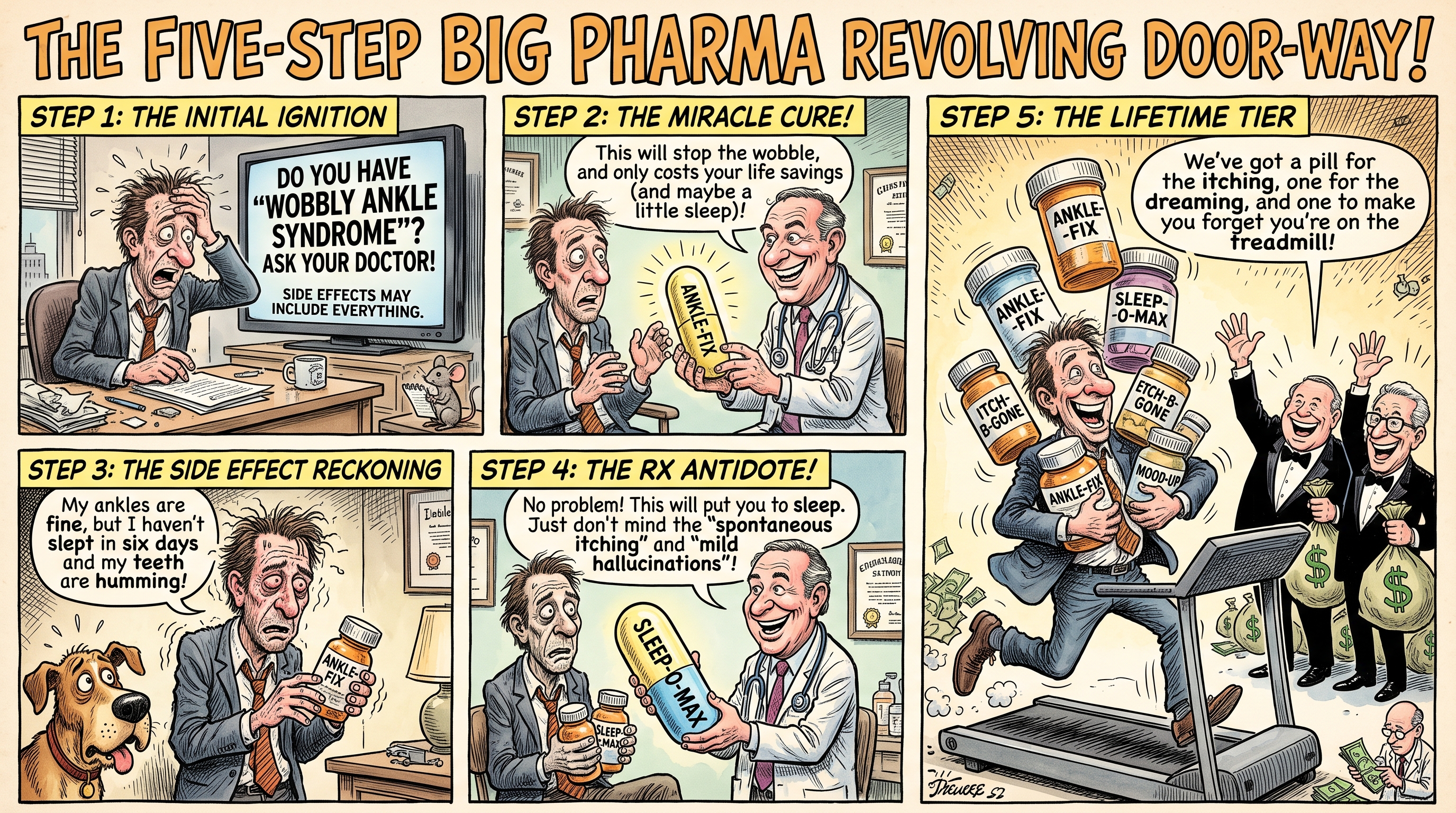
If biotech is the Wild West, Big Pharma is what happens when the Wild West gets accountants.
These companies are enormous. Global sales forces. Manufacturing plants. Thousands of scientists. Regulatory departments large enough to have their own weather system.
And, most importantly, drugs that already make money.
That last part changes everything.
A small biotech can spend ten years trying to prove one molecule works. A company like Eli Lilly can have billions flowing in from drugs doctors already prescribe while spending billions more figuring out what comes next.
That is the Big Pharma business model:
Sell today's blockbuster while desperately building tomorrow's blockbuster.
The word "blockbuster" matters. A blockbuster drug is the pharmaceutical equivalent of a hit television franchise. It generates enormous revenue, attracts investor attention and makes management look brilliant.
Until the patent clock starts ticking.
Take AbbVie. Humira became one of the biggest-selling drugs in pharmaceutical history. Then exclusivity began to fade and biosimilar competition arrived. AbbVie now needs newer drugs such as Skyrizi and Rinvoq to carry the business forward.
That is the patent cliff.
One drug starts fading, and suddenly Wall Street wants to know what replaces it.
This is why Big Pharma investors spend so much time talking about pipelines.
A pipeline is simply the collection of drugs a company is developing.
Wall Street sees something else:
- Which drug could become huge?
- Which one could fail?
- Which one could replace an aging blockbuster?
- Which one could be licensed?
- Which one could be bought?
And, naturally:
How much money will it make?
Eli Lilly is a perfect example of the blockbuster machine. Its diabetes and obesity drugs, particularly Mounjaro and Zepbound, have turned metabolic medicine into one of the biggest stories in the pharmaceutical market.
Novo Nordisk is playing the same game.
Merck offers a different lesson. Keytruda became a pharmaceutical monster, which is fantastic when it is growing. Eventually, though, investors have to think about what happens when its period of commercial exclusivity becomes less powerful.
Pfizer provides another example.
COVID created an extraordinary revenue boom around vaccines and antivirals. Then the pandemic changed.
The question shifted from:
"How much money can this company make?"
to:
"Okay, what happens after COVID?"
That is the Big Pharma cycle.
Discovery. Blockbuster. Growth. Patent pressure. Pipeline panic. Acquisition. New blockbuster. Repeat.
And this explains why Big Pharma buys biotech.
Sometimes it is cheaper to buy a promising drug than invent one internally.
Sometimes the buyer wants a technology.
Sometimes it needs a new therapeutic area.
Sometimes it needs to replace a future revenue hole before investors notice the hole.
And sometimes management looks at a tiny biotech with one interesting molecule and thinks:
"We could buy that."
The biotech shareholders hear the same sentence and think:
"Please continue."
But there is another way to get the science.
Licensing.
A large pharmaceutical company can pay a smaller biotech for rights to develop or commercialize a drug without buying the entire company. The deal may involve upfront payments, milestones and royalties.
That creates another important distinction.
A $2 billion deal does not necessarily mean someone just handed a biotech $2 billion.
The headline number often includes future payments that depend on the drug actually succeeding.
Read the footnotes.
Big Pharma is therefore not simply a collection of giant drug companies.
It is a portfolio-management business.
Companies are constantly managing scientific risk, patent risk, regulatory risk, commercial risk and capital-allocation risk.
A billion-dollar drug today is not necessarily a billion-dollar drug forever.
The patent clock is always running.
And somewhere inside every pharmaceutical headquarters, someone is already asking the uncomfortable question:
What happens after this drug stops being special?
That question drives an enormous amount of biotech M&A, licensing and R&D spending.
And it brings us to the companies that don't just sell drugs.
They try to build machines for discovering them.
References
- [1]AbbVie Inc.: Reports Full-Year and Fourth-Quarter 2025 Financial Results (Feb. 4, 2026). Humira net revenue decline after biosimilar competition, alongside growth from Skyrizi and Rinvoq.
- [2]Eli Lilly and Company: Annual Report & Form 10-K Filing / Full-Year 2025 Financial Results. Mounjaro and Zepbound revenue as disclosed by the company.
- [3]Merck & Co., Inc.: Annual Report on Form 10-K for fiscal year 2025 (filed Feb. 24, 2026). Keytruda revenue and the company’s disclosure on patent and market-exclusivity timing.
- [4]Pfizer Inc.: Reports Solid Full-Year 2025 Results and Reaffirms 2026 Guidance (Feb. 3, 2026). Decline in COVID-19 products such as Comirnaty and Paxlovid as pandemic demand receded.
- [5]SRS Acquiom / Fierce Biotech: Average biopharma biobucks decline, while upfront deal payments rise (Sept. 24, 2025). Analysis of how much of a headline biopharma deal value is paid upfront versus contingent on milestones.
- [6]STAT News (Damian Garde): What’s behind those billion-dollar biotech deals? Often, a whole lot of hype (Nov. 28, 2016). Why headline “biobucks” deal values overstate the cash a biotech actually receives.
- [7]IQVIA: Biopharma M&A: Outlook for 2026 (Jan. 2026). Patent-cliff pressure and pipeline replenishment as drivers of biopharma acquisitions.
Educational content, not financial advice. Eli Lilly, AbbVie, Merck, Pfizer and Novo Nordisk are referenced here only as illustrative examples of how large pharmaceutical companies manage blockbuster drugs and patent expirations — not as recommendations to buy, sell, or trade any stock, and no price target or forward return is implied for any company named.